John Powell didn’t set out to become one of the world’s leading composers of film scores. But somewhere along the road from playing in youth orchestras to writing for advertisements and being mentored by Hans Zimmer it just sort of happened, and now his beloved music for How to Train Your Dragon 2 is about to receive its live-to-film world premiere at the Sydney Opera House this June.
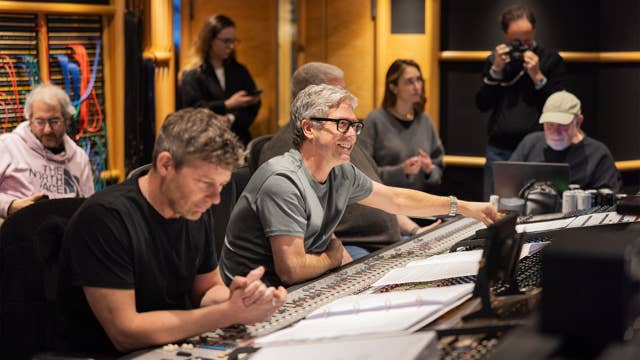
When I speak with Powell it’s from the control room at 5 Cat Studios, the music production facility and record label that he owns in Los Angeles. He is in between projects and generous with his time and answers as we cover a broad sweep of his life and career, his relaxed attitude and wry sense of humour perfectly in keeping with the two very well-behaved dogs sleeping on the couch behind him.
Powell’s accolades are significant and extensive: he has scored over 70 feature films over 30 years, gathering two Academy Award nominations for Best Original Score for How to Train Your Dragon and Wicked, along with six Grammy nominations. He has scored action blockbusters including Face/Off and several of the Bourne movies, but it is in the field of family-friendly animated movies that he has become a leading figure, with Antz, Chicken Run, Shrek, the first two Kung Fu Panda films and both Happy Feet movies boasting a Powell score. Perhaps his best-known work is that of the HTTYD universe: the first three animated films and soon to be two live-action versions.
But Powell’s musical life didn’t begin with animated dragons – it began with his father, James, who played tuba in England’s Royal Philharmonic Orchestra under its legendary founding conductor Sir Thomas Beecham.
“He took me to a rehearsal one day of Mendelssohn Violin Concerto. Dad wasn’t even in that, but I can’t remember the rest of the program. But I remember that I could not find any other way of saying things that I was thinking – and then I heard this piece of music and it said lots of other stuff that there didn't seem to be words for. So it was this other language – and since then I've been trying to speak that language.”
Despite that early awakening Powell wasn’t immediately fluent in this new language. He was given a sopranino trombone at five or six, then took up the violin after the Mendelssohn moment, then switched to viola.
“I have told this story before, but my father would come in and listen to me playing the violin, and one time he listened to me doing a Bach partita and as I finished he said, ‘You'll make a good plumber,’ and walked out – which I obviously took as offense.
“Another time he heard me playing and said, ‘you should go into composition – there’s more money in it.’ And I took equal offense to that, but it turned out he was he was right. I think what he was trying to say is that being a player takes more than I had in me. I couldn't have done it, for many, many reasons – I couldn’t have risen to the level at which I felt music and heard music, and so I'd always be frustrated by it.
‘So I had to make a hard choice when I was in my mid to late teens: “what am I going to do about this?”’
Powell decided to commit to composing and went off to Trinity College of Music, London. Even then his path wasn’t set, and his musical horizons were broadened as much by his studies as by the Northern Soul band that he played in for many years. But as Powell explains, that too was driven by his desire to speak the language of music more fluently.
“I get exactly the same feeling from bits of the Britten War Requiem that I get off of Aretha Franklin records,” he says. “Some things just suddenly connect, and whether it's soul music or jazz or folk music or Bulgarian choirs, all these things I find very potent.”
From there, the diversion into film music – or “music for the image”, as he has called it before, was another happy accident.
“It came from necessity – of finishing college, of not knowing what to do. I went and worked as a tape operator for a while…and then I got into jingles, advertising music. And from that I started to see the fun of working against picture and seeing how you could alter the meaning of what was happening in a visual.
“I was starting to do that in a group with Gavin Greenaway and Michael Petry. We were kind of a little trio of almost performance artists doing installation art things. We did several video installations with some pretty crazy music, all of us trying to see the meaning, the differential between picture and sound, what you're trying to say with each of them and how they combine and change to mean something else entirely. So that became very interesting.
“I was doing lots of adverts in London and Paris, and then I met Hans Zimmer through that same company because he used to do adverts for them and he needed some help. And then it kind of sort of ran off from there.
“But I had done a lot of work before I met him. I forget how many things I had done. I obviously hadn't done any films, but I had done some TV and lots and lots of adverts. So when I did go over to Hollywood, within about 18 months I got my first film, which was Face/Off, which was about 140 minutes of music but felt like 140 adverts!”
That Powell’s Hollywood career began with a science fiction action thriller, directed by one of the major figures of Hong Kong action movies, starring Nicholas Cage and John Travolta as a megalomaniac super villain and the FBI agent trying to bring him down is rather funny when you consider where his career has taken him.
Not long after Face/Off, Powell was asked by an upstart new animation studio called DreamWorks, to score their first film, Antz. That marked the start of an extraordinary run of animated family films that Powell has scored, including The Road to El Dorado, Chicken Run, Shrek, two Ice Age films, Horton Hears a Who! and Kung Fu Panda.
But in fact it was in Australia that Powell had the real revelation that it was family movies – not grand dramatic masterpieces – that are his calling.
“I said to George Miller when I came to do Happy Feet that scoring those sorts of movies are really easy for me,” he recalls with a smile. “Citizen Kane is not a film that does anything for me, but Babe is – Babe is the highest art form in cinema that I had ever seen. So that was how I found my way into that world – I guess I'm suited for family entertainment, for fun things.”
“And I got such an education [working with Miller]. That's where did my master's degree. I don't actually have a master's degree, but I kind of like to think I did my master's with George, because he was the first one to really explain every and everything he was doing and why. It was an incredible gift he gave me on that.”
Powell came to know Sydney pretty well during the making of Happy Feet and its sequel.
“I was involved right at the very beginning, and I was on that for three and a half years. I did ten trips to Sydney in those three and a half years while we did all the music, because obviously they needed the music first to animate all of the numbers.”
“And ironically, the very first time I ever saw a live-to-picture film was The Wizard of Oz at the Sydney Opera House. I was working on something with George at the end of 2003 or so. And it was amazing! Apart from the fact that it’s such an incredible score, incredible songs. And I never thought I'd get to do one myself. And then it was suggested for Dragons…”
‘Dragons’, of course’, being How to Train Your Dragon – perhaps Powell’s magnum opus and certainly the films that have shaped the last fifteen years of his career. The first film came out in 2010 and did so well that two sequels followed in 2014 and 2019, and the series expanded with a live-action remake in 2025 – and a sequel to that has already been announced.
Live-to-film presentations of the first movie have been plentiful in the past decade, but the Sydney Symphony Orchestra will give the world premiere live-to-film performance of How to Train Your Dragon 2 at the Sydney Opera House on 25 June.
It’s exciting for all involved, but Powell would like to start by apologising to our musicians for how incredibly difficult it is to perform live.
‘It's a very hard blow [for the Brass], it really is,’ says Powell with a wry smile. ‘But the timpani part's impossible as well, because we have too many timpani notes [in my synthesizer] that we can go to, so you never think about [having to perform it live].’
‘It’s very hard stuff,’ he continues. ‘And the keys – some of the string writing is not comfortable at all, the ranges of some of the wind writing is not good and the trumpet writing is way too high, often. Between all of those things I would obviously like to apologise to all the orchestras.’
Despite all these apparent shortcomings, the How to Train Your Dragon films are regularly programmed by orchestras around the world. And not just once, but again and again.
‘There is a lot of repeat business,’ says Powell. ‘Partly it's the musicians saying, “if we have to learn it, we should play it again – and I appreciate that. But obviously the audiences are enjoying it, and it seems to be doing well because of that. It's a very wonderful feeling that these orchestras are enjoying it.’
If the popularity of these concerts is anything to go by, it won’t be the last time the Sydney Symphony Orchestra performs something from John Powell’s musical universe. And it’s nice to know that there are more dragons in the pipeline…
