Who We Are
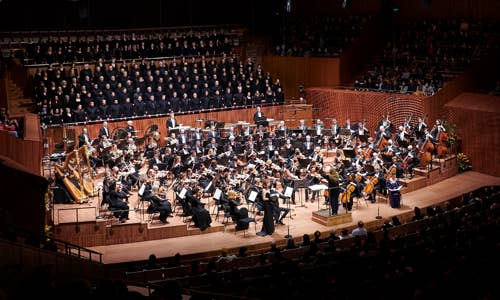
The Sydney Symphony Orchestra is Australia’s flagship Orchestra and performs up to 150 concerts a year to a combined annual audience of more than 350,000.
Our History
A permanent symphony orchestra is a sign of a city's musical maturity, and Sydney moved closer to achieving this when the Australian Broadcasting Commission was established. That was in 1932, the opening year of another symbol: the Sydney Harbour Bridge.
1932—The first ABC Sydney Symphony Orchestra
The Sydney Symphony Orchestra had a promising predecessor. From 1919 to 1921 the Orchestra of the New South Wales Conservatorium, conducted by the Belgian Henri Verbrugghen, gave regular professional symphonic concerts in Sydney, as well as touring Australia and New Zealand.
The new Australian Broadcasting Commission (ABC) enlarged the studio orchestra it had inherited from the Australian Broadcasting Company to 24 permanent players, and this group sometimes performed as the ABC Sydney Symphony Orchestra. Some of the players who had joined before 1932, such as flautist Neville Amadio and timpanist Alard Maling, remained leading members of the Orchestra for some decades.
ABC broadcasts from the studio stimulated public demand for orchestral concerts, but at first public concerts, for which the Orchestra was augmented, were special events. These included the Brahms and Wagner Festival in 1933 under Australian conductor Bernard Heinze, and concerts in 1934 under Sir Hamilton Harty, the first overseas conductor brought to Australia by the ABC.
1936—Subscription concerts begin
In 1935 the ABC – led by its Chairman William James Cleary, General Manager Charles Moses and Music Advisor Bernard Heinze – increased the Orchestra to 45 players, augmented to 70 for public concerts. The result was a permanent orchestra suitable for concerts as well as broadcasts.
The following year the ABC launched its first Sydney series of subscription concerts. Sir Malcolm Sargent was the featured overseas conductor, followed by Georg Schneevoigt, George Szell and others. Soloists included the pianists Arthur Rubinstein and Artur Schnabel and returning Australians such as cellist Lauri Kennedy.
During World War II, events such as the Beethoven festivals fed a public hunger for great music, many Australian service men and women had their first experience of orchestral music in special concerts. As musicians enlisted, more women joined the ranks of the Orchestra, and resident soloists and conductors filled the gap left by international visitors. Bernard Heinze continued audience development in school, children's and youth concerts.
1947—Goossens and the modern Sydney Symphony Orchestra
Following the recommendations of visiting conductor Eugene Ormandy, the ABC built the Sydney Symphony Orchestra to full symphonic strength, collaborating with the state and municipal governments. An 82-player Orchestra gave its first concert in January 1946, and Eugene Goossens was persuaded to become the Orchestra's first Chief Conductor (and Director of the Conservatorium), beginning in 1947.
Goossens said he wanted to make Sydney's orchestra 'among the six best in the world'. He also said Sydney must have an opera house and chose a site at Bennelong Point, on Sydney Harbour. Goossens introduced Sydney audiences to orchestral works old and new, and many were Australian premieres, including Stravinsky's Rite of Spring and Australian John Antill's Corroboree. His 1953 EMI recordings were the Orchestra's first international releases.
Notable guest conductors during the Goossens years included Otto Klemperer, Rafael Kubelik and Sir John Barbirolli. Goossens appointed players who were to shape the Orchestra's sound for years, notably Ernest Llewellyn as concertmaster. Llewellyn's predecessors included Lionel Lawson, his successors Donald Hazelwood (another long-serving concertmaster), John Harding, Michael Dauth and Dene Olding.
Goossens was succeeded as chief conductor by Russian Nicolai Malko (who died in Sydney), American Dean Dixon, and Israeli Moshe Atzmon. In the 1960s, ABC Director of Music and conductor John Hopkins initiated and conducted the Town Hall Proms concerts, still fondly remembered today. In 1965 the Orchestra made its first international tour, including an appearance in the Edinburgh Festival.
1973—Willem van Otterloo
The Orchestra's next long-lasting relationship was with Dutchman Willem van Otterloo. Notable milestones of his term were a 1974 tour to Europe, following the Orchestra's first concerts in the Sydney Opera House, opened in 1973.
One of the conductors in that opening season was Australian Charles Mackerras, a former oboist in the Orchestra. In 1982 he became the Orchestra's first Australian Chief Conductor, succeeding Frenchman Louis Frémaux. Mackerras conducted Wagner in concert in collaboration with the Australian Opera, and the Australian premiere of Berlioz's Trojans. When Mackerras fell ill in 1985, the young Australian conductor Stuart Challender stepped in. Following the brief tenure of Czech Zdenĕk Mácal, Challender was appointed Chief Conductor, commencing in 1988.
1988—Stuart Challender
Changes in the ABC's management of music and concerts had given the Orchestra, in 1985, its first General Manager (and later Managing Director), Mary Vallentine, and under Stuart Challender the Orchestra's international reputation and commitment to Australian music increased.
Music by Peter Sculthorpe and Carl Vine featured on the 1988 tour of the USA, and their works along with those of Ross Edwards were issued on ABC Classics CDs, conducted by Challender. Among the performance highlights were Mahler symphonies and Wagner, including staged productions of Tristan and Isolde in Sydney and the Adelaide Festival.
1994—Growth and change under Edo de Waart
After Stuart Challender's too-early death the Orchestra forged a relationship with noted Dutch conductor Edo de Waart. As Chief Conductor he guided the Orchestra on tours of Europe and Japan and Taiwan and made many recordings with the Orchestra for ABC Classics. The Orchestra played a major role in the 2000 Sydney Olympics and the Olympic Arts Festival, including a performance of Mahler's Eighth Symphony and the culmination of a concert Ring Cycle.
New players were appointed, recruited from Australia and overseas, including returning Australians. The Sydney Opera House Concert Hall, already its main venue for performances, became the Orchestra's home for rehearsals.
In 1994 the Sydney Symphony Orchestra was identified as Australia's flagship Orchestra in Prime Minister Keating's Creative Nation policy. Funding for increased player numbers, recording and touring accompanied steps towards eventual divestment of the Orchestra from the ABC. The relationship with the ABC continues through broadcasts of most of the Orchestra's concerts, some of which were also streamed in partnership with Telstra Australia.
2004—International impact: Gelmetti and Ashkenazy
In 2004 Gianluigi Gelmetti, a regular guest since 1993, became Chief Conductor. Gelmetti conducted the complete Beethoven symphonies in 2007, and a concert presentation of Puccini's opera La Rondine complemented earlier Wagner ventures. Gelmetti will also be remembered for idiomatic Debussy and Ravel, and for his Shock of the New concerts. Australian Liza Lim was Composer in Residence from 2005 to 2007.
In 2004 Vladimir Ashkenazy, returning as a conductor, renewed his relationship with the Orchestra, which had begun in the 1960s with the first of his appearances as a pianist. Two weeks of Sibelius programming proved an artistic highlight and set the template for annual composer festivals: Elgar, Rachmaninoff and Prokofiev.
In 2009 Ashkenazy became the Orchestra's Principal Conductor and Artistic Advisor. He took the Orchestra on tours to Europe and Asia and conducted a Mahler symphony cycle in 2010–2011, one of several projects linked with recordings on the Sydney Symphony Live label (established in 2006) and Japan's Exton/Triton label.
2014—David Robertson
In 2014, American conductor David Robertson, a frequent guest conductor since 2003, took up the post of Chief Conductor and Artistic Director which he held until 2019. He brought to the Orchestra extensive experience both in Europe and the United States, and a gift for persuasive programming and talking about music. His projects included annual Opera in the Concert Hall productions, collaborative programs involving film, dance and other art forms, and the creation in 2016 of the Carriageworks series, featuring music of our time in a fresh, contemporary space. Under his leadership, Australian composer Brett Dean was appointed the Orchestra's first Artist in Residence.
2020—Sydney Opera House renewal and COVID
Following our 2019 Season the Sydney Opera House Concert Hall closed for long-scheduled refurbishments as part of the House’s Decade of Renewal. The Orchestra’s plan was to base ourselves at our first home, Sydney Town Hall, but for our schedule and scale of programming to be otherwise unchanged.
Of course, that did not come to pass.
The COVID-19 pandemic had a seismic impact on the Orchestra, with Federal government health orders to limit large crowds making it impossible for us to even gather the full Orchestra for a rehearsal, let alone perform to 2,000 people in a concert hall. From 1 January to 13 March 2020 the Orchestra presented 34 public performances as originally planned, while from 1 October until 15 December we opportunistically presented some closed, limited performances to patrons as government restrictions allowed.
2021 arrived with renewed hope and reduced health restrictions in place, and from 1 January until 19 June the Orchestra presented 44 public performances. Sadly from 20 June no further performances were possible.
Instead we shifted our efforts to digital music performances online, with an emphasis on works written by living Australian composers. There were collaborations with the Sydney Dance Company and the Actors Benevolent Fund, 33 Sydney Symphony At Home performances by our musicians in whatever-sized groups were permissible, as well as a small number of chamber and orchestral performances filmed at Sydney Town Hall and City Recital Hall when restrictions allowed.
Despite two interrupted years, all filled Orchestra and administration positions were maintained.
2022—Simone Young
Wednesday 20 July 2022 will go down as one of the most significant dates in the history of the Sydney Symphony Orchestra: not only as the commencement of Simone Young’s tenure as our Chief Conductor but also our return to the Sydney Opera House Concert Hall after a two-and-a-half year absence. That dislocation was all the more profound given it coincided with the COVID-19 pandemic. But this week of performances saw the Sydney Symphony Orchestra roar back to life.
Fittingly, the centrepiece of these performances was Mahler’s ‘Resurrection’ Symphony, an enormous piece of music that took on even greater significance after all that we had endured in the preceding years. Broadcast live on ABC television and featuring performances from Sydney Philharmonia Choirs and Sydney Children’s Choir, this was a moment for Sydney, New South Wales and the entire Australian arts community to signal that we were back in action. These concerts also featured Of the Earth by William Barton, commissioned specifically for the occasion and a thrilling convergence of Western classical traditions with the oldest living culture on Earth.
From that incredible starting point, Simone Young’s tenure as Chief Conductor has gone from strength to strength. This chapter in our history has been marked by projects of enormous scale and ambition, revelatory explorations of core repertoire and enthusiastic responses from critics and audiences alike. Highlights under Young have included the Sydney premiere of Schoenberg’s Gurrelieder, our presentation of Wagner’s Ring Cycle in concert – with one opera performed each year over four years – and each new Season has begun with acclaimed performances of Mahler’s orchestral works.
A major acknowledgement of the quality of the Sydney Symphony Orchestra’s performances came in 2025, with the release of the Sydney Opera House Reopening Concert on vinyl, CD and digital platforms by German record label Deutsche Grammophon – making us the first Australian orchestra to appear exclusively on the famous ‘Yellow Label’ in its 125-plus year history.
Concurrent with Simone Young’s tenure as Chief Conductor has been the appointment of Sir Donald Runnicles as our Principal Guest Conductor. A musician of tremendous empathy and grace, the Orchestra’s weeks with Runnicles are deeply engaging and fulfilling and have seen unforgettable performances of both core and unusual repertoire, from the symphonies of Brahms to Australian premieres of music by German composer Detlev Glanert.
Completing our Artistic Leadership, in 2025 Benjamin Northey was announced as the Orchestra’s Conductor in Residence, with a particular focus on our Learning & Engagement programs. Northey has had a long relationship with the Orchestra going back to his earliest professional engagements, and his passion for developing the next generation of conductors and musicians makes him the ideal figurehead for this vital area of our activities.
Concerts and Beyond
The skill and dedication of generations of musicians and planners have made the Sydney Symphony Orchestra the fine instrument it is for concerts, broadcasts and recordings, and extended its activity throughout the community.
Eugene Goossens pioneered open-air concerts, taking advantage of Sydney's climate and physical beauty. Outdoor concerts in Sydney and later in Parramatta have commanded crowds in the tens of thousands. Each year the Orchestra presents performances in outer metropolitan and regional centres, and children's and education concerts.
The Sydney Symphony Orchestra's Learning & Engagement Program helps ensure the Orchestra's future audiences and players. Its antecedents are in the Youth Concerts (begun in 1947) and the ABC's training orchestras. The Youth Concerts have broadened into concerts series featuring programs that combine standard, new and Australian music. Family Concerts provide opportunities for parents to introduce children to concert-going in a lively and engaging atmosphere. And the Sydney Symphony Orchestra Fellowship program provides a key stepping stone to the profession for emerging young orchestral players.
As we look toward our centenary in 2032, we are driven by our purpose of inspiring and enriching lives through music and by our goal of becoming a leading international symphony orchestra on and off the stage.
Our Chief Conductors
SIR EUGENE GOOSSENS 1947–1956
NICOLAI MALKO 1957–1961
DEAN DIXON 1964–1967
MOSHE ATZMON 1969–1971
WILLEM VAN OTTERLOO 1973–1978
LOUIS FRÉMAUX
Chief Conductor 1979–1982
Principal Guest Conductor 1982–1984
SIR CHARLES MACKERRAS 1982–1985
ZDENĔK MÁCAL 1986
STUART CHALLENDER
Principal Guest Conductor 1986–1987
Chief Conductor 1988–1991
EDO DE WAART 1994–2003
GIANLUIGI GELMETTI 2004–2008
VLADIMIR ASHKENAZY 2009–2013
Principal Conductor
DAVID ROBERTSON 2014–2019
SIMONE YOUNG AM
Chief Conductor Designate 2020–2021
Chief Conductor commencing 2022