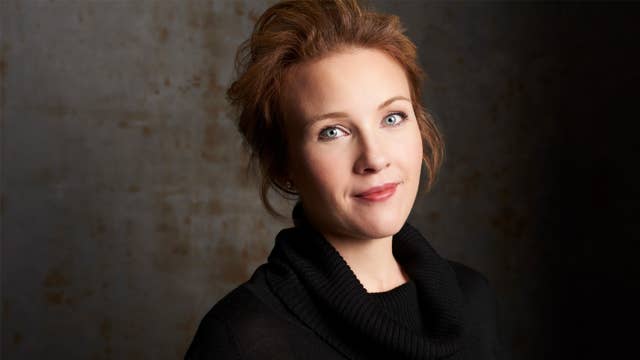
Perhaps it is not surprising that American mezzo-soprano Sasha Cooke pursued a career in the performing arts. Both her parents taught Russian at university in Texas and Cooke’s father is big classical music aficionado who would take his daughter to concerts from the age of five.
But thank goodness she didn’t listen to the only opera singer in her early life, a family friend who, when asked for advice for the musical, creative 10-year-old Sasha, could only swoon dramatically and say, ‘Don’t become an opera singer, it’s a very lonely life!’
Though that didn’t turn Cooke off the idea completely, she admits that it did prove daunting during her teenage years and as she began to get more serious about music as a vocation.
‘[That conversation with the family friend] was my one memory as a 10-year-old, and I thought, “Gosh, well, I'm not going to be an opera singer!”’ But it wasn’t just because of that warning. ‘I thought they were super human,’ Cooke recalls. ‘I remember some of my first opera experiences thinking they must be alien – I was so blown away by opera singing.
‘In my high school years I heard Samuel Ramey sing Mephistopheles at Houston Grand Opera, and he sat on the edge of the stage and he had sort of a painted devil's chest – and something hit me like a lightning bolt. And I got really serious about opera.
‘But I just never thought it would happen. And that was sort of my story as a student: everywhere I went I thought, “Surely, I'm not going to get in. This is not going to happen. Surely, surely.” And the doors kept opening.’
Music opened its arms to me.
Cooke – the two-time Grammy Award-winning mezzo-soprano – makes her Sydney Symphony debut this week, performing Edward Elgar’s Sea Pictures under the baton of Principal Guest Conductor Sir Donald Runnicles in a ravishing, dramatic concert that also feature Wagner’s Overture from The Flying Dutchman and Sibelius’ sweeping Second Symphony.
Elgar’s Sea Pictures are relatively well-known thanks to a landmark recording by Dame Janet Baker, but they have rarely been heard in Sydney: since our first performance of the work in 1948 the Sydney Symphony has only performed it a handful of times.
They are exquisite, rich songs that sit alongside the landmarks of the orchestral song repertoire like Strauss’ Four Last Songs and Mahler’s Song of the Earth and Cooke cannot wait to perform them, despite admitting to some trepidation.
‘They are kind of daunting,’ admits Cooke. ‘That's sort of why I'm drawn to them – because the poetry is very evocative and mysterious.’
‘I think I like them because they're peculiar,’ she continues.
There’s just nothing else that you'll ever hear like the Sea Pictures of Elgar.
‘I've done his Dream of Gerontius a few times, and for the English, Gerontius is kind of like the Messiah – it's very much a spiritual experience. I also think Elgar is a spiritual composer. And his sound – when you hear the opening, immediately you know it’s Elgar. There's no one else that it could be. I love composers like that, where they have a thumb print and a musical identity that you get immediately.’
‘And what I love about these songs is that they’re so quirky, with a sound world that feels very watery and very mysterious. But then there are moments of grand, grand English song, majestic and glorious big, big, big brass and all the things you imagine grand music making to be. It goes from both worlds, from this dark mystery colour to very English, poised, grand music-making.
‘It's a special experience to hear something that's rarely performed. So come and enjoy it as an experience, and marvel at something written 125 years ago that's very unique.’
Cooke is also looking forward to reuniting with Sir Donald Runnicles, who she regards as ‘one of the great conductors of our time’. The two have worked together a number of times at some of the world’s great opera houses and just last month gave the world premiere of Australian composer Alex Turley’s the ocean’s dream of itself at Sir Donald’s Grand Teton Music Festival in Wyoming.
This varied history of collaboration between Cooke and Runnicles reflects Cooke’s own career which has seen her move effortlessly between the opera stage and the concert hall. Her two Grammys are for portraying fascinating characters in contemporary operas (Kitty Oppenheimer in John Adams’ Doctor Atomic and Laurene Powell Jobs in Mason Bates’ The (R)evolution of Steve Jobs). Cooke was nominated for a third Grammy for her 2022 solo album, how do i find you, which in many ways reflects her interests as an artist: Cooke commissioned composers in their 40s and younger to respond in their own way to the turmoil and upheaval of the COVID-19 pandemic, with seventeen songs by Nico Muhly, Caroline Shaw, Missy Mazzoli and more combining to create an intensely personal journal of a difficult time.
In its review, Gramophone magazine remarked that ‘Cooke tells these stories as if she had experienced them herself, imparting subtle yet significant changes of mood and character for each song.’ That ability to change character is crucial in the performance of Sea Pictures, which consist of five poems presenting five different depictions of the ocean and therefore requires five quick shifts of character.
Cooke is a big believer that a singer should create a character for themselves when performing concert works, even if the character is a thinly-veiled version of yourself.
‘It's always better when you do,’ she says. ‘It can be you – it can be you in a certain context or a certain atmosphere, a certain memory. You can be the character. But it always serves the music so much better if you do your actor's duties and figure out intention and context and circumstance. If it's abstract poetry and it doesn't mean anything to you, then when you get on stage you're just singing syllables and vowels.
‘I always say, especially to young musicians, we are the only instrument that faces the audience. We look into their eyes. It's incumbent on us to make that inner story super interesting. And it could be anything – it could be chocolate chip cookies, or Abraham Lincoln, we can be so many things. No one knows, and what's so wonderful about it is that it’s private. But if it's not there, it's really apparent.
‘I love something [American mezzo-soprano] Susan Graham said once, which is that we get to have therapy on stage – which is true! We are going through all of these human emotions all the time, living them and confronting ourselves and confronting difficult topics and confronting our mortality day in, day out.’
There is a story that, at the very first performance of these works, the singer Clara Butt took to the stage dressed as a mermaid. Cooke won’t commit to leaning that far into a character, but does acknowledge it would make sense given how sensual and enigmatic the songs are.
Is there a final image or idea that she would like people to have in mind while listening to these songs?
‘These songs are like entering a Turner painting,’ she says. ‘They are very dark and murky, but beautiful with radiant, shimmering light. They are nebulous, and you'll enjoy the cerebral experience that they are.’