‘It’s Wonderful That It’s for Everybody.’ Stephen Layton on the Universal Appeal of Music
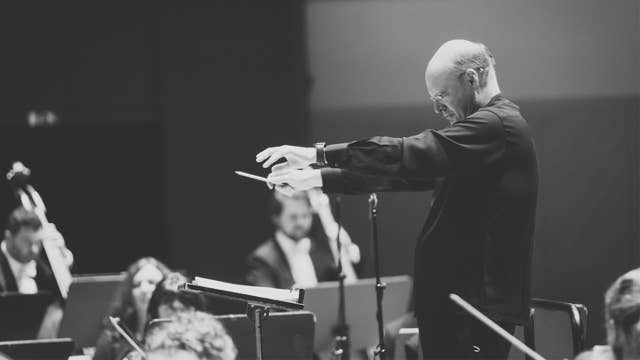
Stephen Layton has been steeped in music his entire life.
His father was a church organist, and Stephen was a chorister at Winchester Cathedral before winning organ scholarships to Eton and then King’s College, Cambridge to study under the famous choral conductor Stephen Cleobury. While at Cambridge Layton founded the vocal group Polyphony (‘possibly the best small professional chorus in the world,’ according to Encore Magazine), and for seventeen years he was the director of music at Trinity College, Cambridge, whose performances and recordings have won countless awards and set the global standard for choral music.
Since stepping down from Trinity College Layton has spent more time as a traveling international conductor, and we are thrilled to be welcoming him back to Sydney in August for a concert of 18th century masterpieces. Layton’s Sydney Symphony debut in 2023 was unforgettable, leading JS Bach’s Magnificat alongside choral works by the contemporary Latvian composer Ēriks Ešenvalds in a program of stark, crystalline beauty.
The Sydney Symphony Orchestra doesn’t perform an awful lot of music from the Baroque and Classical eras, tending to focus on Beethoven and beyond, so it is exciting to be performing a selection of 18th century masterpieces with one of the world’s leading experts in this repertoire.
Music of the Baroque (roughly 1600–1750) and Classical (1750–1830) eras is often pigeonholed as delicate, precise, small-scale private affairs lacking the intensity or drama of the Romantic era. But as Layton points out, Handel’s Music for the Royal Fireworks in particular is music of great pomp and bombast.
‘The Fireworks music was written to celebrate the end of war,’ says Layton via video call from his home in Norfolk, England. ‘Handel was commissioned by George II – and written for an enormous orchestra of something like 24 oboes, nine trumpets and half a dozen timpani. Something like 12,000 people were crammed onto London Bridge to try and get to the premiere in Green Park.
‘I think we naturally put Handel into a more genteel era because a lot of his music is sacred, textual, thoughtful arias in opera and oratorio, but it's interesting to see that there’s a relationship here with the king, with monarchy, with power; a connection between the state, the country, and the monarch with the art that's coming out. We see this in England in Henry VIII’s time with Hans Holbein, the great painter, to some extent with Tallis and Byrd, with Elizabeth I in England, but probably no more so than with Handel.
This program also offers a snapshot of what was happening across Europe in the 18th century. As Layton points out, all four of the works on this program were written within at almost the same time as each other: Bach’s cantata Jauchzet Gott in allen Landen in 1730, Handel’s Music for the Royal Fireworks in 1749, Haydn’s 44th symphony in 1771 and then Mozart’s motet Exsultate, jubilate, written in 1773.
‘I’m struck by the development and variety of music in a 40-year period,’ says Layton. ‘This is a program that shows what is happening in Europe in a microcosm: the Bach is heard in Leipzig, the Handel is heard in London, the Mozart is heard in Milan and finally the Haydn in Esterhazy [Austria].’
‘It’s interesting that although today we talk about the global village, and how we can access music of all types and all kinds from all places in the world, it’s all the more remarkable to realise that Bach, Mozart and Handel were all accessing a cultural milieu outside where they were born, where they’re living, through their travels.
‘Handel is writing operas in Italian, Mozart is writing operas in Italian and German, then you look at Bach and you see different French suites, German suites – you sense very quickly that actually “Europe” as a landmass of all these different countries was already very interconnected in the sharing of its culture.’
The sharing of culture is something that comes up a few times in our conversation. Layton is a wonderful communicator about music, a deep and passionate thinker able to draw connections between music across time, geography and genre.
Despite his deep roots in a very formal musical education, Layton doesn’t at all subscribe to the belief that you have to be schooled in classical music in order to appreciate it. Indeed, despite his intricate knowledge of how music works, he is far more interested in how music makes us feel.
Things happen in music that do things to us as human beings – stir us, make us sad, whatever. We hear things which change our mood.
‘What’s interesting for the musician is to understand what might be happening “scientifically,” if you like, in inverted commas, and how we know what is going on because there’s this extraordinary contrast between this key and this moment, et cetera. But I’m convinced that the human race also hears these things, but they don’t name them. It’s a key change, it’s whatever, but there’s still the actual essence of something happening in the music, and this is reaching out and speaking to people in a unique way.
‘I think it’s possible to receive music without any sense of education about how it was conceived. And thank goodness it is possible that people can come to a concert without having to have that knowledge because if they did have to have that knowledge, music would be something very much just for a few people. It’s wonderful that it’s for everybody.’