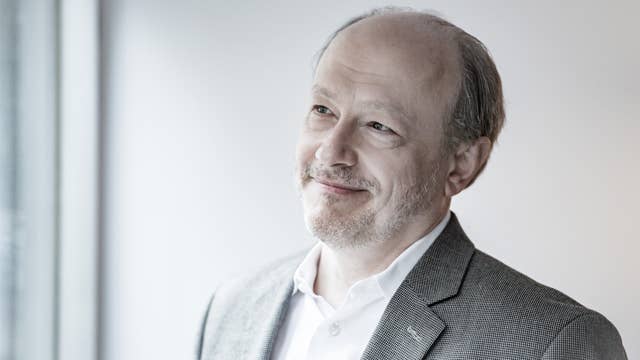
Over the course of a career spanning five decades, Marc-André Hamelin has cemented a reputation as one of the great pianists of the modern era.
The Canadian pianist has won eight Juno Awards and been nominated for twelve Grammys, been praised as a ‘performer of near-superhuman technical prowess’ (The New York Times) and ‘admired for his monstrously brilliant technique and his questing, deep-thinking approach’ (The New Yorker). In a world of pianism populated by countless aspiring virtuosos,’ says Interlude, ‘Hamelin stands at the head of the class.
So it is quite a surprise to realise that September 2025 will mark Hamelin’s debut with the Sydney Symphony Orchestra. But he is making up for lost time, with two performances of Beethoven’s Fourth Piano Concerto under Sir Donald Runnicles scheduled as well as a solo recital of Beethoven, Medtner and Rachmaninov.
With so much to catch up on – and look forward to – we spoke with Hamelin a few weeks ago to get his insights on what he will be performing in Sydney this September.
On his musical childhood
I grew up in a semi-musical family. My father was a pharmacologist by profession, but his main love was music. He was a very good amateur pianist, he had perfect pitch and he actually worked on some really advanced repertoire – but never played in public as far as I know. He abandoned the study of music rather early on, but it was always his wish that one of his children would do something in music. I think I probably surpassed his wildest expectations!
He passed away back in 1995, but he did live to see me start getting a good foothold in the musical world. He was very, very happy about that.
On his first piano lessons
It was a very nurturing environment. I wasn't pushed. I didn't have a tiger mom or whatever, none of that. My mother was very appreciative of classical music even though she never learned an instrument.
But my parents always supported me and I'll be always super grateful for that. My dad didn't force me into lessons. I remember he asked me, ‘would you like to study piano?’ And of course I said yes at that point – what did I know? But I was fascinated with what he was doing at the piano. Apparently I would come up to the piano and just stare open mouthed at what he was doing. So when he saw an interest, that's what he did.
And I never stopped. It was a natural thing and I seemed to have some facility and there was never any question that I would continue. But I think it only congealed into a really serious sort of potentially lifelong occupation only gradually - by my early teens it was pretty obvious that I would do this, but also that I wasn't really talented for anything else!
On what sustains him as a performer
There are as many discoveries in this field as there are venues to play in. It's really quite wonderful.
One of the other aspects is the immensity of the pianistic repertoire. And I'm very open to exploring it and finding new things. It's a horn of plenty. Of course a lot of it hasn't survived the ages. But there's still hidden gems in there.
When I do these repertoire explorations I try to think not so much of pleasing myself, but what is going to please the audience and what is going to stimulate them and make them potentially want to find out more.
Is there something that links Beethoven’s Fourth Piano Concerto with his Hammerklavier sonata?
These two works happen to be the exceptions within the canon of their works.
The Fourth Concerto, if you consider all five, that's really the unique one because it is less concerned with – and I’m not talking about the musical content – it's much less concerned about the instrumental display. But it achieves, I think, much more profundity – as wonderful as the other pieces are. With Beethoven, I've always admired the sense of absolute proportion and the magnetism of the thematic material, where everything somehow seems inevitable. And that's really one of the things I admire the most.
The Fourth Concerto is an exception among the five. To me, it clearly stands out.
The sense of serenity that it exudes – the first movement alone is an absolutely marvellous creation. And it floats more than the other concerti. The other concerti exposes the pianist, introduces the piano, but the fourth is on another plane. And I think spiritually it's different.
And there's no need to say that even though all five of the late sonatas are extraordinary works in their own way, the Hammerklavier really stands out as almost an anomaly. It's really the most outsized sonata he ever wrote. It explodes everything as far as form, as far as content, as far as willingness to go to extremes.
In coming to Sydney I didn't really plan that I would be displaying these two exceptions within the two different canons of Beethoven's. It's just the way that it came out.
On what he hopes for his audience
Not only me, but all my colleagues want the audience’s lives to be enhanced in some way. To come out of the concert with a renewed sense and a renewed love for what we present. And this is talking generally, of course, but also maybe an enhanced appreciation of these individual composers.
It sounds simplistic, but why not?
On the repertoire for his solo recital, music by Medtner and Rachmaninov
Nikolai Medtner (1880–1951) is someone who rarely makes his best impression on a first hearing. Partly because he requires a lot of care and interpreters really have to put in a lot of know-how, a lot of savoir-faire, into best presenting it to the audience.
That is a case where I have to think of the listener first and foremost. My greatest fear is to lose the listener, so I always make sure that there's something to hang on to, that what I present is always as understandable as possible. As understandable as a spoken text, for example, with meaning, punctuation, sentences, paragraphs, whatever. So if you help Medtner along in this way you have a better chance of having it understood from the very first.
If you stick with Medtner his world is something that you will start quickly to find irresistible and you'll want more of it.
I still believe in Medtner. What I'm playing in this recital are two of his most remarkable short pieces, actually. The first is the Improvisation, Op.31 No.1 in B flat minor, and the other is the Danza Festiva, Op.38 No.3, which is a tremendously effective piece.
I haven't said my last word on Medtner, certainly, because he was a marvellous creator. Rachmaninov said repeatedly that he thought that Medtner was the best contemporary composer at that time. Rachmaninov also dedicated his Fourth Piano Concerto to Medtner, so there’s an obvious connection.
And Rachmaninov had a really unique harmonic language too. And as is superfluous to mention, you know, a very, very, very high propensity for writing very memorable melodies.