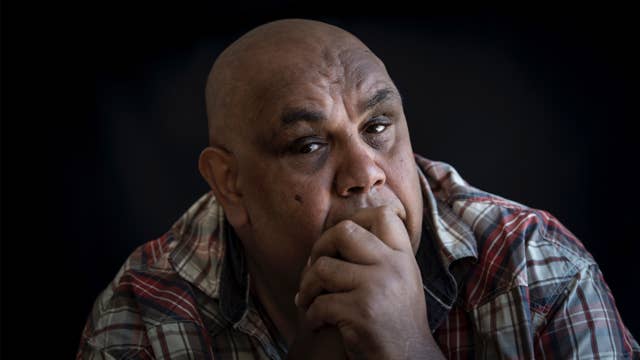
An interview with Mutti Mutti, Yorta Yorta, Nari Nari songman Kutcha Edwards isn’t a standard question and answer.
It’s more lying in the grass and watching clouds pass overhead: all sorts of memories and ideas float by, piercing insights mixed with heartfelt reminiscences, and every so often a familiar shape comes into view that grounds you and brings you back to reality.
That same sense of timelessness exists in his music, too. Kutcha calls his style ‘Bidgee blues’, named after the Murrumbidgee River on the banks of which he was born; you would likely find it filed under ‘roots’ music. But there is so much more to it, and not just because of Kutcha’s powerful voice that cuts through the instrumentation like a clarion call. There is a weight of lived experience that has accumulated over the decades, but that is leavened by a lightness of touch and generosity of spirit.
Over the course of an hour long video call Kutcha makes it very clear that he wants to engage people and bring them along. He wants a conversation.
‘People have been suggesting to me that this concert with the Sydney Symphony, Ngarli-Wangu, is a show – but it’s not a show, it’s a conversation,’ says Edwards. ‘All I’m really trying to do is have a conversation with individuals, not a mass of people.’
This concert will see several others join the conversation with Kutcha: not just the Orchestra and conductor Benjamin Northey, but also several very special guest artists.
‘Ngarli-Wangu in Mutti Mutti language means ‘our voice’. It’s not about me, or this entity Kutcha Edwards. It's about our voice, across different age demographics: Emily Wurramara, Shellie Morris my sister, Ray Dimakarri Dixon, my brother, and then you have the senior auntie, elder, Kankawa Nagarra, and it's about us all having that conversation with the Sydney Symphony and the audience that are to be in attendance.’
Kutcha has been trying to have this conversation for a long time.
If you visit Kutcha’s website, you will see his logo: a boomerang and a clapstick sit alongside each other to form the letter ‘K’, while behind it are blue concentric circles representing ripples in water. Kutcha is a big believer that actions can have unknowable consequences, rippling out and touching more lives in more ways than you could ever imagine.
That is how he imagines his life and career because it is the way he has experienced his own life: chance encounters, improbable coincidences, past and future aligning in ways that seem pre-ordained.
There is no better illustration of this than how he came to be called ‘Kutcha’. Born Glenn Gordon James Edwards, he was forcibly removed from his family when he was just 18 months old; he didn’t see his mother again until he was seven and wasn’t allowed to live with her until he was 14.
He remembers a conversation with his mother shortly afterwards when he asked her about his name and decided that these European names didn’t mean anything to him. Instead, he decided he wanted to be called ‘Kutcha’ – a name that meant nothing to him, that had no connection or significance, but one that he had heard ‘in the ether, in my Dreaming.’
At about the same time, on his first day at Traralgon Tech, the teacher asked Kutcha’s class to write a poem, one that told a story about themselves. A big ask for any 13 year-old, let alone one whose sense of self was fractured by dispossession and removal.
This is what he wrote:
Trickling down the waterfall,
Freely one by one,
Forming into clouds of spray,
Glistening in the sun.
Crushing to disaster,
My water drop is done.
Left a short life of loneliness,
And gathered back as one.
Many years later, by this stage already a successful artist and traveling the world, Kutcha happened to meet up with Pitjantjatjara singer and songwriter Frank Yamma, who has a song in his own language called ‘Kunka Kutcha’. Struck by that word showing up in a language based roughly 1,500km from where Edwards was born, he asked Frank what it meant – and the answer stopped him in his tracks.
‘He said, “one”’, Kutcha recalls with wonder in his voice. ‘He said, “one.”
‘How did that 13-year-old boy sense that word? I turned 60 in November. How did he profess his journey before it even began? How did he know?’
That poem now features in Kutcha’s concerts all around the world, as the lyrics of a song called ‘My Favourite Drop’. It’s the throughline of this performance, arranged by Kutcha and collaborator Roscoe James Irwin to form river a music that runs through the emotional landscape of this concert, Ngarli-Wangu.
Another unconscious coincidence is that this concert at the Sydney Opera House falls on 14 October 2025 – exactly two years since the Voice referendum. It’s a date of great poignance and sadness for Kutcha, yet another in a life full of them. But it’s an opportunity too.
‘The date, the 14th of October, is two years on from the failed Voice referendum, where metaphorically, Aborigines were told our voice doesn't count. [The proposal] was nothing to do with politics – it was about giving Aborigines a voice.
‘[The result] saddens me, but it's a lived reality for me. I've lived it all my life. I was forcibly removed and I'm used to it. But an old mentor of mine, my surrogate father, his name's Jock Austin, he instilled in me a lot of the philosophies that I have carried with me throughout my life. And Jock would always say to me, “It doesn't matter how many times you get knocked down, it matters that you get back up.”
‘Music has taken me around the world, and it has given me the opportunity to have those conversations that we were told we weren't supposed to have on the 14th of October two years ago.
‘And the irony is that this little black duck has got his voice in the biggest concert hall in the Southern Hemisphere.’
Who knows what will ripple out from Kutcha’s concert on 14 October 2025. Whatever happens, it’s a great opportunity for us to take part in the ongoing conversation that Kutcha is so eager to keep having.


