As you settle into your seat after interval this evening and allow your eye to wander idly over the stage, you may notice a couple of unexpected instruments. Now, it’s true that before reaching them, your eye may wander over quite a few other instruments first. For his breathtaking picture of climbing and descending a mountain, Richard Strauss called upon an enormous orchestra: quadruple winds, a brace of harps, a huge brass section, and a wind-machine and thunder-machine for the storm scene, possibly the best in all of music. (That said, the ‘Calm Before the Storm’ section, when the bottom drops out of the world, is even more extraordinary. No other composer has so vividly shown the limitless space of wild places.) The instruments you’re seeing for the first time, though, are two alphorns.
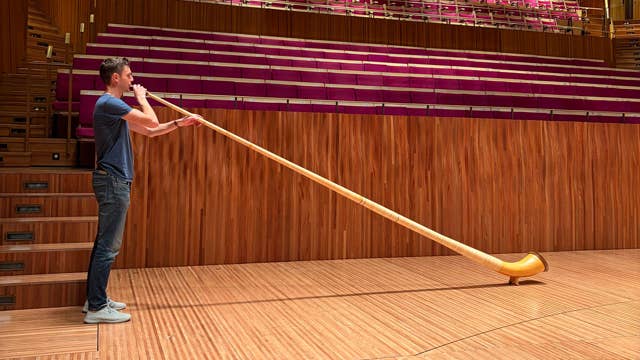
These curious instruments are traditionally made from a tree trunk, split lengthwise and hollowed out. To get the hockey-stick angle at the end, the tree must have grown outwards from a very steep slope, and then headed up to find the sun; the root end then becomes the bell of the instrument. Such trees aren’t easy to find, and today alphorn makers carve the instruments from larger blocks of wood. There are more alphorn makers out there than you might think. The German firm Alphorn-Center, which made the Sydney Symphony Orchestra’s instruments, offers 23 different models, including one which doubles as a walking stick. Another firm makes one from carbon fibre, which weighs a couple of kilos and telescopes to fit in your suitcase. Ours are three and a half metres long and break into sections for easy transport. Should you see someone leaving the Opera House lugging something resembling an overgrown cricket bag, check the logo. If it doesn’t say Gray-Nicolls, it’s possibly an alphornist.
Despite being constructed from a tree, the alphorn technically belongs to the brass family. Taxonomy of musical instruments is based on how they produce sound, and alphorns are played by ‘buzzing’ one’s lips into a mouthpiece, just like a trumpet. This produces the notes of the harmonic series, the naturally occurring scale which is the basis of all Western music. (Think of those whirly tubes which were popular in the ’80s: the distinct pitches you discover by whirling at a constant speed are the harmonic series of the tube.) When playing alphorns, then, Samuel Jacobs and Nick Byrne are fundamentally doing the same thing as in their regular jobs as Principal Horn and Section Trombone. But the sound is completely different: it’s a mellow, low, boomy hoot, which can carry an extraordinary distance. This is why, for centuries, they were used for signalling across the valleys and mountains, and for calling back the herds.
So when Strauss got to ‘On the Alpine Pasture’, the ninth of the 22 brief sections which make up An Alpine Symphony, he deftly sketched the scene. He wrote the chirrup of small birds on the piccolo. He wrote oboes and the little E flat clarinet fluttertonguing (going ‘rrrr’ while playing), which sounds uncannily like sheep. He wrote for cowbells, covering the other livestock. And he wrote, in the woodwinds, a motif which is a classic alphorn call.
Here the picture shifts to the not remotely mountainous city of Philadelphia, where I travelled in 2022 to present at the 40th annual conference of one of the world’s more niche communities, the Major Orchestra Librarians Association (MOLA). This fabulous organisation encompasses librarians of orchestras, opera houses, conservatoriums, and military bands around the globe. Every day – believe me! – a MOLA member puts out a desperate cry to the hivemind and is rescued from catastrophe within the hour. And before long, that same MOLA member will be doing the same for somebody else. And then, at the conference, they buy each other a beer.
At Philadelphia, I found myself at the vendor table for the venerable German music publisher Breitkopf und Härtel, leafing covetously through their exceptionally beautiful scores. The chap minding the table, Nick Pfefferkorn, introduced himself (diffidently neglecting to say that as well as being a distinguished musicologist he is Breitkopf’s managing director). He pointed out their new An Alpine Symphony, which he’d edited. ‘We discovered’, he said, ‘that Strauss wrote in this piece for alphorns, and we now have included them.’ I practically gibbered with excitement.
Nick explained. In all his sketches, Strauss consistently wrote the word ‘alphorn’ at this passage. In ‘On the Alpine Pasture’, the full orchestral manuscript has two blank staves at the top of the score – and Strauss wrote the alphorn motif in the wind instruments in red ink. Nick deduced that Strauss had planned to write alphorn parts in the blank staves, and the red ink would be optional for performances without them. At a late stage, though, he changed his mind. It’s not clear why, but one possible reason is that professional brass players in his day wouldn’t have lowered themselves to play a peasant instrument. Moreover, when Nick recreated the part it turned out to be quite tricky: finding a shepherd who could play it would have been difficult, even had it been socially acceptable.
Well – I came back to Sydney and told absolutely everybody about it, including, of course, Simone Young, who was totally up for the adventure. And here we are. This edition has never been played with the alphorns, although the piece was done in the US a few years ago with the parts semi-improvised.
A few weeks ago, the Sydney Symphony Orchestra hosted the MOLA conference here in Sydney (the first outside North America or Europe). For one session, Nick Byrne, Samuel Jacobs, and Scott Kinmont played their collection of antique brass instruments, and Nick (Pfefferkorn) got to hear Nick and Samuel playing our alphorns. (He breathed, ‘This level of artistry…’) It was a lovely MOLA moment. Larry Tarlow, Principal Librarian of the New York Philharmonic, says that before MOLA existed, orchestra librarians were ‘independently inventing the wheel. And if the guy in the next valley has already invented the wheel…’ And to signal to the guy in the next valley? You need an alphorn, of course!
Alastair McKean is Head of Library at the Sydney Symphony Orchestra and was the 37th President of MOLA.
Copyright © Alastair McKean 2026. All rights reserved.
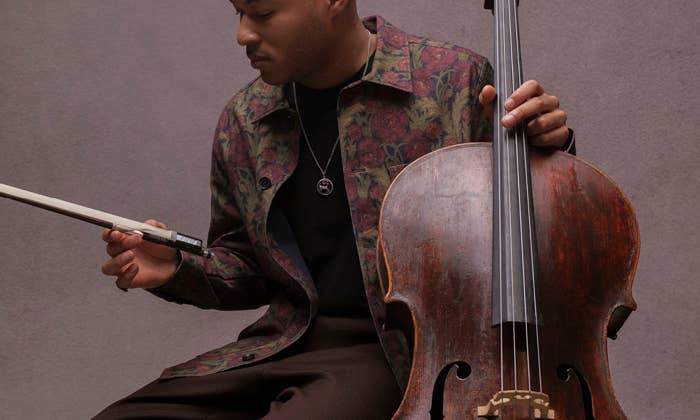
Simone Young & Sheku Kanneh-Mason
Sheku Kanneh-Mason’s Elgar is irresistible. Simone Young’s command of Strauss’ music invigorating. If it’s emotion you’re after, this is a program of deep feeling and vast scale.