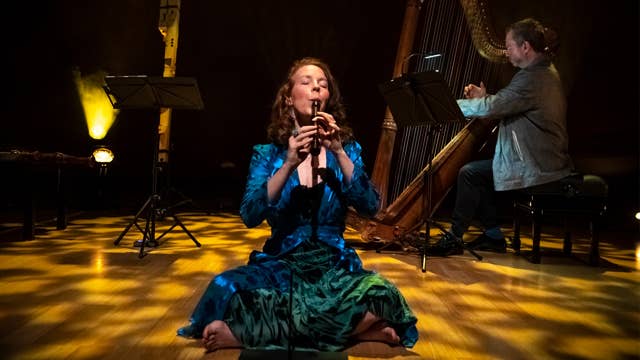
For many, merely mentioning the recorder brings back memories of primary school and the enthusiastic squeaking of a roomful of children. Genevieve Lacey has spent a lifetime confounding those expectations, demonstrating the extraordinary potential of these instruments through her own exquisite playing and genre-defying programming.
Her compelling musicianship and passionate advocacy has seen her become one of the most admired artists in the industry, winning countless awards both at home and abroad, serving in artistic leadership positions around the country and restlessly pushing the boundaries of not just her own instrument but of music in general.
Remarkably, in her decades-long career, she has never once worked with the Sydney Symphony Orchestra – something that will finally come to pass in Sydney and Wollongong later this month when she leads a program she is calling Labyrinths of Time, a journey through more than 400 years of music that demonstrates a small but compelling slice of her musical world. It’s a concert that ranges from the 15th century to the 21st (including a world premiere), touches on classical music, folk tunes and sea shanties and above all else explores the way that music manipulates time and our perception of it.
This wide-ranging and eclectic program reflects Lacey’s own musical background. She was born in the highlands of Papua New Guinea where western classical instruments were hard to come by, but after the family moved to Port Moresby she found a community of recorder players and never looked back.
‘That's how it all began, and then I was incredibly fortunate – we moved a couple of times, first to Canberra and then to Ballarat in regional Victoria, and in both those places we found extremely positive teachers,’ she recalls with a smile. ‘Those people that literally change your life and change the lives of many people in the community. I really owe a great gratitude and joy and skill to those brilliant teachers when I was a child.
‘Then I did more formal training, first at Melbourne and then in Switzerland and Denmark, then came back to Melbourne and did some more studies. I've had the great privilege of a long formal education and being in many different contexts where people think about music quite differently.
You know how they say it takes a village to raise a child? I think it takes multiple different locations to raise a musician.
In conversation Lacey is thoughtful and considered, pausing before answering questions and occasionally mid-sentence when searching for precisely the right word. She has an incredible energy: wide-eyed and idealistic and ambitious but with a steeliness tempered by decades of carving out a niche in Australia’s musical landscape.
‘I think my family would probably say that it was clear to them quite early [that I would spend my life in music] because I was just possessed with music. I was one of those unusual children where parents would never need to ask me to practice. I just loved being inside sound and that connection between your imagination and your own emotion.’

One of the challenges for an aspiring recorder player is that there aren’t traditional pathways in the way that there are for other orchestral instruments. Lacey acknowledges that the pathway for her instrument ‘is perhaps more flexible, more improvised’ than for others, but is quick to pay homage to those who paved the way for her.
‘In Australia we have a long and amazing tradition of recorder players, so there's a generation of pioneers prior to me – almost two generations – who already were forging quite extraordinary paths and doing something that hadn't been done in this country before. I was mentored and supported by really courageous, imaginative, generous people, so I had these incredible role models quite early.
‘But I had lots of practical people in my life, who loved me very much, who were very concerned about that [lack of clear pathway], understandably. “Are you sure? Are you really sure? Is it even possible to do that in Australia?” But I guess I just decided to do it.
‘I was met with such generosity by listeners, by colleagues, by presenters, by all the people in our community who helped to make music happen, keep it alive through their connection with it.
I feel like I've been unbelievably fortunate in this life in music, and for me the of taking these humble beautiful instruments and just sort of going, “What would happen if…” is endlessly fun.
One gets the sense that Lacey had endless fun putting this program together, an eclectic mix of sounds and styles from around the world and through the centuries, from Alice Chance (born 1994) to Gilles de Bins dit Binchois (c.1400–1460).
As Lacey explains, it all started with her sitting and thinking about time, and falling down a rabbit hole of the work of the Italian philosopher physicist called Carlo Rovelli – as one does.
‘He talks about time in really mind-blowing ways,’ says Lacey, the wonder and awe clear in her voice. ‘I was thinking about music, which is a time-based art – it only exists in time, yet it's intangible – and its ability to warp time when we listen to it. Suddenly time stops, or it stretches, or it takes us back in our own memories.
‘I started thinking about trying to construct a program that might have that kind of an effect on a listener, and that might celebrate composers who play with time in particular ways. So quite a few of these pieces are composers are looking to times outside their own historical period for inspiration. And that's interesting to me.
‘Also on my mind was that my instrument is one that that Sydney Symphony listeners don't encounter live often, so I wanted to bring some core repertoire for me, as well as just take them on a listening adventure to places where the orchestra might not so regularly go.’
Central to this program is the world premiere of a brand-new work by Australian composer Lisa Illean, Swellsong.
‘I love Lisa's music,’ Lacey says. ‘I have been listening to her avidly for many years now. She writes music that's deeply sensitive, highly intelligent, very understated in a kind of exquisitely refined, still way – and I always thought that something about her sensibilities would match the recorder very beautifully.
‘The Orchestra were generous enough to support this commission, and Lisa was kind enough to find time in her very busy schedule to write a new piece for bass recorder. It’s very quiet, beautifully sonorous, quite fragile and really kind of aching. I can’t wait to play it.’

‘[When building a program] primarily I'm trying to think about it from the audience's perspective. I really like to try to concoct listening experiences for people that that will take them in and out of quite different worlds – but somehow that there's some intuitive link between them.
‘In this instance it was very much about linking what I felt were aesthetics or sensibilities between these sound worlds or these composers. Much of what people will hear is really quite gentle. And if it's not that, it's gently joyful. There is folk songs, with sea shanties and reels – and of course the recorder has a long association with all those kinds of forms. There’s a little thread of dance-like music, as well as things that are more abstract.
‘I'm hoping that someone sitting in the hall can hold onto things that they know or that feel familiar, and then gently drift on a tide of something that's not so familiar but somehow feels related, and then perhaps go a little bit further out to sea and then come home again.’

Listening to Lacey talk about her unfairly maligned instrument is like listening to someone describe a dear friend – in she agrees that her relationship with her recorders is an extremely close one.
‘I love them dearly,’ she enthuses. ‘They are such extraordinary companions through my life. We travel together, we spend thousands of hours together and I am playing them for hours and hours every day. I think most musicians have a really particular relationship with their instrument, but with these I literally breathe life into them. There’s a deep connection there.
‘They do each have such different characters. I love that about them. To me – even though there's no logic or science in this – they are creatures, and if you really pay attention to them they come alive in your hands. They are wooden and they notice the surroundings: temperatures, humidity, getting on and off planes.
‘Also, if I play one instrument too much it gets tired. Because it absorbs moisture, it can sound like it's got a slightly husky throat, or it's got a bit of a cold. I love that, because they're wooden, they are organic and alive.’
What could be better than an evening of music-making with friends?

