Hitting the Right Notes: Nigel Westlake and Rebecca Lagos on a Striking New Concerto
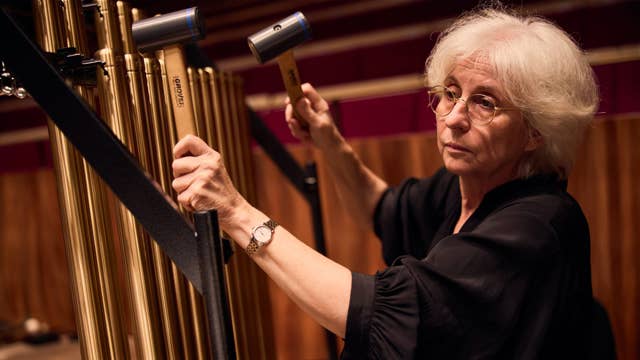
It’s not often you get a second chance to make a first impression. But that’s precisely the case for Australian composer Nigel Westlake and his “new” percussion concerto, When the Clock Strikes Me…
Originally written for Sydney Symphony Orchestra Principal Percussion Rebecca Lagos in 2006, Westlake has “cherry-picked the best bits” for a complete rewrite which will be re-premiered at the Sydney Opera House in May, again with Lagos as soloist.
It’s not as if the 2006 version wasn’t a huge success: it was met with glowing reviews and was awarded Best Performance of an Australian Composition at the 2007 Classical Music Awards (now known as the Art Music Awards). But Westlake wasn’t satisfied.
‘Twenty years ago I was overwhelmed at the incredible way Rebecca played it and the way the Sydney Symphony really got into it, but I never felt that the idea was fully realized,’ he explains. ‘It didn't have enough sense of tension and release. It felt a bit flabby, it was too long. So this is shorter – the original one was almost 30 minutes long, but this version is twenty minutes. So it's more concise and it gets to the point much quicker, and maintains that sense of drive and direction with much more efficacy than the original version.’
Drive and direction it has in abundance. This is a propulsive, compelling work that surges with energy from its very first notes – unsurprisingly, given the form and content of the inspiration for the work.
‘The work came about when my son introduced me to a poem by the American beat poet Saul Williams,’ explains Westlake. ‘Even though I'm not into rap and beat that much I was attracted to certain aspects of this poem. It's a very edgy and declamatory work…and describes a sequence of disarming and life-affirming revelations, the central theme being that some moments are so profound that they transcend time and space.
‘I love the idea of the constant ticking clock in the background. Everyone goes through their moments of revelation and enlightenment or awakenings – and these moments distort our sense of time and reality – and yet we always come back to the ticking clock.’
‘This is of what the music does,’ he continues. ‘It starts off with a very disarming, very simplistic approach: a ticking clock, realised by Rebecca with a weird collection of little wood blocks and metal gadgets. Then the music speeds up, it slows down, it becomes distorted and backfires on itself, then it drags the orchestra into this sort of whirlwind of activity which peaks and then we come back all of a sudden to the ticking clock again.’

We are having this conversation in Rebecca Lagos’s rehearsal room at her house in Sydney’s inner west, completely surrounded by more percussion than you can shake a stick at.
Lagos is naturally thrilled to have the chance to revisit this major work, a rare opportunity for percussionists to step to the front of the stage. But more than that, it’s a chance for her to spend more time in Westlake’s musical world.
‘I have always loved Nigel’s music, but especially the way he writes for percussion,’ she says. ‘I've always thought he was a bit of a closet percussionist because he seems to understand it so well and writes for the instruments really well. He uses the colour but also the rhythm in such a great way.’
As it turns out, Lagos isn’t far off the mark.
‘I've always had a great fondness and passion for percussion,’ reveals Westlake. ‘When I was 11 years old my grandmother took me to the Sydney Town Hall to hear the great sarod player Ali Akbar Khan – and his tabla player was the genius Zakir Hussain, who was just a few years older than me, just a young kid playing this unbelievable stuff.
‘I harboured a fantasy of going to India to study tabla. But I thought my dad [Donald, Sydney Symphony Principal Clarinet from 1961–1979], was probably not going go for that idea. So I put it away and didn't really think about it much – but I've always held a special place in my heart for percussion.

‘I’ve got a wonderful relationship with the SSO section for starters, especially Rebecca – we back a very long way and we've done all sorts of projects together, recordings, film scores, various pieces with the Sydney Symphony and chamber music. She's got a great sense of what I'm after and is always sourcing the right sounds for me to write for.
‘That’s very much the case with this concerto – Becky has spent a long time selecting beautifully tuned pieces of metal junk, gongs from all sorts of places and strange and weird and wonderful things.’
Even if the music weren’t brilliant, it would be worth the price of admission just to witness the small city of instruments Lagos will wield in this concert.
As she takes us on a tour – gongs over here, marimba here, cast iron frying pans she bought from a kitchen supply store here – she makes the point that, unlike traditional concertos written for one single instrument, percussion concertos are written for the entire family of instruments at once. Because of this, much of Lagos and Westlake’s collaboration on this project has been working out what is physically possible to play.
‘It took at least a week of figuring out how to set the piece up,’ says Lagos with a wry laugh. ‘A week of setups, fiddling around, moving things around, trying things out, seeing if I could reach everything.
‘Writing for percussion is like writing for a new instrument,’ she explains. ‘The soloist essentially has to learn a new instrument, which is made up of a lot of different instruments, if that makes sense.
‘Nigel came up with the original instruments that he wanted to use – and I've actually always wondered how he comes up with those instruments – and then he would bring it to me and we would discuss it and talk about whether it was possible and whether I would actually physically be able to reach all the instruments.’

Despite the sheer number of individual percussion instruments on stage, When the Clock Strikes Me… never once feels like an assault on the ears. There is tremendous variety written into the soloist’s score, from the warm wooden tones of the marimba to Chinese opera gongs that bend the note and the shattering thwack of the thundersheet, Lagos takes pains to explain this is a work of fascinating textures and aural experiences.
‘It's different to the way a lot of percussion concertos work,’ she begins. ‘Nigel uses the instruments with other instruments all the time, rather than just concentrating on one set of instruments then moving to another set then moving to another set – and a lot of percussion concertos can be like that. It's all integrated. It's really interesting. I love the way he writes for percussion,’ she reiterates with a big smile.
You can tell Westlake is pleased to hear such positive feedback from his dedicatee. ‘That, to me, is my way of embracing the percussion. I think when people come to hear a percussion concerto I think they want to be surprised, they want to be delighted, they want to be thrilled and excited by the energy. The first version of this work didn't really do that for me, but I'm hoping that this one does.
‘The other thing about percussion is that I just love the way it works. It's very theatrical. You see all these instruments on stage, you see someone about to hit something, and it inspires questions that other concertos don’t. “Now what? What's going to happen? What's she playing now? What's that going to sound like? Is it going to be loud, soft, fast, slow?”
‘That in itself is a sense of theatre, and all that anticipation is a beautiful thing. So I hope it will be very entertaining, musically enriching and quite thrilling – especially in terms of the virtuosity of the players involved, particularly Rebecca.’
