In High Fidelity, Nick Hornby’s beloved novel (and later film) about the neuroses of a certain type of music-obsessed man, our protagonist has a long monologue about how ‘the making of a compilation tape is a very subtle art,’ with many dos and don’ts about sequencing, the juxtaposition of one track with another and so on. ‘This is a delicate thing.’
The same is true of designing a concert program, but with so many more variables thrown in. What is the soloist prepared to play? What is the conductor an expert in? How many musicians, and what instrumentation, are available to us? How long is the concert? When did the orchestra last perform these pieces? What comes before and after this concert in the season? It is a high-wire act juggling so many competing demands.
At first glance, then, this upcoming concert featuring works by Rossini, Saint-Saëns and Shostakovich might seem completely incoherent. What could possibly link these three composers from three different countries, spanning three centuries, and stylistically worlds apart?
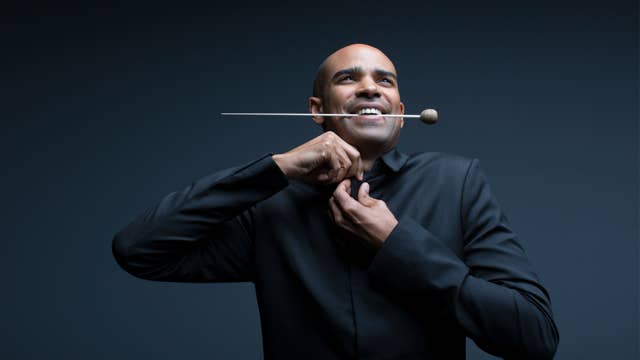
Conductor Kevin John Edusei completely agrees – but there is method to the madness!
‘It’s a program that when you look at it on the page, and you're not familiar with the pieces, you might see a clash of different styles and composers that looks very, very weird,’ he says with a smile. ‘But when you look into the pieces, there's a very strong connection – we are dealing with three last pieces in a way.
‘William Tell was the last opera that Rossini wrote and we're playing that famous overture by him. We are playing the last piano concerto of Saint-Saëns, which probably also has a certain meaning for him being a pianist himself. And then also we encounter Shostakovich's last symphony, which he wrote just a couple of years before he passed away, knowing that this would be his last effort to produce a larger orchestral form.’
But it’s not just that these pieces were written at similar times in their composers’ lives – Shostakovich goes so far as to quote Rossini’s overture in his symphony.
‘There's this little connection, that haunting motif that Shostakovich used in the first movement of his symphony, which is taken really as a quote from Rossini,’ continues Edusei. ‘It’s a very weird quote that starts to live its own life, in a way, within the symphony.
‘Shostakovich was often asked why he used this motif, and he couldn't explain it himself. He said, ‘there was no way I could not have used this motif – but I can't tell you why.’ And that speaks to the enigmatic character of Shostakovich, and also the enigmatic qualities of his music in general.’
That’s probably the greatest quality of Shostakovich’s music. He is one of the greatest symphony composers after Gustav Mahler, and you can find meaning in every corner of his writing, but still in general the enigma stays.
It certainly speaks to this enigmatic quality to both the man and his music that, 50 years after his death, we are still debating the minutiae of Shostakovich’s life, poring over his contested biography for any clues about the music. But, as Edusei points out, the biography wouldn’t be nearly so fascinating if the music didn’t hold up to so much scrutiny.
‘That’s the fascinating thing about the last symphony because I think this is really boiled down to what the artistic process for him as a composer is and where the difficulties to produce music of meaning lie for him as a composer. I think this symphony is really the essential Shostakovich and how he molds motives, how he creates tension, how he filled space and how he reflects also on his musical biography.
‘I think it’s a very special symphony out of his canon of fifteen symphonies. And it is really great to explore this with the Sydney Symphony.’
While Shostakovich’s standing has only increased since his death, it’s not unfair to say that Camille Saint-Saëns’ popularity has waned. Saint-Saëns was a famous musician for almost his entire life: a child prodigy who made his concert debut at the age of 10, he was head organist at the official church of the French Empire for 20 years before leaving that post to become a wildly successful freelance pianist and composer, widely regarded as the greatest living French composer at the end of the 1800s.
Yet a little more than a century since his death in 1921, his music is rarely performed outside of a small handful of pieces; the Sydney Symphony has only performed this ‘Egyptian’ concerto twice, in 2010 and 2018. This despite his clear skill as a composer, in particular the spectacular array of colours he is able to elicit from an orchestra.
Edusei agrees, adding, ‘melody comes really easy to him, but then there’s also this background as an organ player – so that melody is always informed by intricate counterpoint lines. There’s a lot to find within the music and also a lot that speaks very directly to your musical receptors.’
Saint-Saëns was also an enthusiastic traveler, with nearly 200 trips to 27 countries documented, from professional engagements in Germany and England to holidays in Algiers and Egypt. His ‘Egyptian’ Concerto was inspired by one of these trips, composed in 1896 while on holiday on Luxor, one of the most important centres of ancient Egypt and among the oldest continuously inhabited cities in the world. It bears its origins on its sleeve, incorporating a Nubian love song that Saint-Saëns heard boatmen on the Nile sing, and later the piano and orchestra making sounds intended to evoke frogs and the chirping of crickets.
‘It’s a fantastic piece,’ says Edusei with a broad smile. ‘I really love it, and within the piano concerto repertoire I think it holds a very, very special place. It is full of fantasy, and an experienced composer explores ideas in a very free and rhapsodic way.
‘The second movement – which is, by the way, fiendishly difficult for any orchestra to accompany because it has to follow the free flow of the soloist all the time – is full of little episodes and different tempi and different moods. It reflects on the musical findings that Saint-Saëns had when he visited Egypt.
It’s lovely that we get to present this piano concerto – and now that I hear that it hasn't been played that often in Sydney before I'm even more motivated to bring this piece.
It is exciting for us, too, to welcome Edusei back to Sydney. It has been a big two years for the conductor, with debuts with the New York Philharmonic and at Vienna’s famed Musikverein, plus return visits to the London Philharmonic, the Netherlands Radio Philharmonic and the conclusion of his tenure as Principal Guest Conductor of the Fort Worth Symphony Orchestra in America.
And of course there was his Sydney debut in 2024, in concerts Limelight acclaimed as ‘first-rate’, praising ‘Edusei’s finely judged tempi and spacious, nuanced reading’ of Grieg’s Piano Concerto and Dvořák’s New World Symphony.
Some conductors – and some orchestras too – can occasionally fall into a paint-by-numbers approach to such famous pieces. Happily, that is not Edusei’s approach – nor, as he found out, is it the Sydney Symphony’s.
‘It was very exciting week in Sydney, my first time not only with the orchestra but also in the city of Sydney,’ recalls Edusei. ‘We had a quite accessible and popular program, but it was really revelatory in terms of what we discovered in the music. That was a very intense musical experience that I’m really grateful for.’
Certainly we are grateful – and excited – for another week with this fabulous musician.