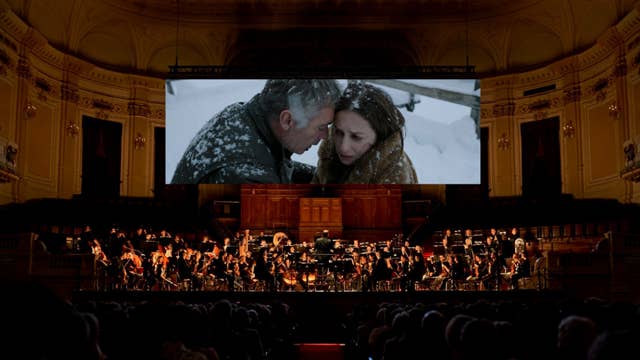
Music and movies go hand in hand. Classical music is often described as “cinematic” – sweeping, dramatic, all-consuming – and music has been used to heighten on-screen drama since the earliest days of moving pictures. It has always been that music is cut to fit the images – but what if it was the other way around?
What if the film was being edited in real time, responding to the live performance with all its nuance, variation and unpredictability? What if a film served the music, rather than the soundtrack supporting the movie?
Sydney audiences will be able to experience exactly that in May, with the world premiere of LOSS by Dutch filmmaker Lucas van Woerkum, a silent film set to The Planets by Gustav Holst. Van Woerkum will sit on stage with the Orchestra and a digital touchpad, “playing” his film in time with the Orchestra’s performance conducted by Benjamin Northey.
Van Woerkum is no barbarian at the gates of classical music, seeking to ransack the citadel. His love for orchestral music is deep-seated, sparked like so many by attending a performance of Peter and the Wolf as a child.
His path to Symphonic Cinema began when he was studying French horn at the conservatorium: Van Woerkum began studying film as well – partly to avoid spending ‘the rest of my life playing on a piece of copper.’ Gradually his interests merged and he shifted to trying to capture music on film. While he was still at school he made a film about Mahler’s Ninth Symphony set against the final days of Riccardo Chailly’s tenure as Chief Conductor of Amsterdam’s famous Royal Concertgebouw Orchestra, which he followed with a series of documentaries on contemporary composers including Arvo Pärt, Tan Dun and Elliot Carter. But after making his first work of fiction, he realised it was much more satisfying to create the story himself rather than documenting someone else’s life.
‘I thought, what if I could turn stories in classical music into drama films? It was not even an idea – it was more like, “how can I combine this passion for classical music and making drama films?”
‘It started with small tests, small five-minute pieces that I turned into small drama films, and then in 2011 I created The Isle of the Dead, the first Symphonic Cinema film [based on Rachmaninov’s work of the same title]. That was recently performed in Montreal, so it's funny to see that these films, like the music, are being played over and over.’
So how does it actually work? Essentially the film is just another instrument, with Van Woerkum sitting on stage with a digital touchpad responding directly to the conductor. ‘Every single shot of the film is being triggered live by me,’ he says. ‘I have the ability to slow down and speed up the film to make it more directly synced to the music.
‘I am reacting to the emotions and the tempi and the dynamics of the orchestra,’ he continues. ‘You need to give the musicians the freedom.’
It sounds incredibly stressful. ‘Well, yes – but you get used to it. And I was a French horn player,’ he says with a laugh. ‘That's even more stressful.’

Over the past fifteen years Van Woerkum has made several more films along the same lines: Firebird (2013), based on Stravinsky’s ballet; Daphnis & Chloe (2018), after Ravel; and The Echo of Being (2020), inspired by biographical elements from the lives of Gustav and Alma Mahler and their young daughter Maria and set to excerpts from his Second, Fourth and Ninth symphonies.
This latest film, LOSS, follows a husband and wife (played by real-life couple Emma Thompson and Greg Wise) and tracks their individual journeys after one of them dies. It’s a touching and philosophical work about the afterlife, a subject Van Woerkum has explored in two of his previous films.
‘The Isle of the Dead is about the fear of dying, and then The Echo of Being is about the process of going to the afterlife,’ he explains. ‘And then I thought, “If I really want to show my ideas I should try to interpret afterlife. What is afterlife in my opinion?”
‘I read a lot of books about near-death experiences and about how different religions think about the afterlife, and then I realized The Planets would be a great piece to show what I hope for – that the afterlife is a celebration of your life. So it's not a dark film. There are some darker moments in the music, but I really wanted to make a soothing film about the theme of dying and of what will happen maybe after you die.’
It’s a long way removed from the literal depiction of planets spinning that we have seen on countless concert programs and album covers, but Van Woerkum argues that we have been representing the music wrong this whole time.
‘All the research I did for The Planets came together in the idea of Imogen, Holst’s daughter, who said that The Planets are actually a progression of the human soul,’ he reveals. ‘You could interpret it as a journey of someone, because it's more about the astrological meanings of the planets than the astronomical importance.
‘The Planets was [originally] called “Seven Pieces for Orchestra”, so Holst was not very focused on the meaning of the planets themselves,’ he continues.

Van Woerkum’s desire in making these films is to deepen people’s connection to and understanding of the music, making clearer the emotional landscape of the composer’s lives so that listeners can more clearly understand the musical landscape.
‘I always thought of the concert hall as a sort of a church. Because for me, it's not entertainment, like going there with popcorn and a drink. It's more like a collective experience that you have together.
‘Of course, if you have this 100 or sometimes 200-piece orchestra with choir on stage, that in itself is an experience on its own. If I, with my film, can lead the minds or the hearts of the audience a bit in a direction, so that it becomes easier for them to understand what the music is about – that is my ideology.’
Let's try to change the way we experience music a bit.
Sydney audiences are about to discover that Symphonic Cinemas projects are a compelling package – they certainly swept Emma Thompson away when she first encountered it. Thompson’s husband, Greg Wise, starred in The Echo of Being; Thompson was at its world premiere with the Royal Concertgebouw in Amsterdam, and immediately told Van Woerkum that she wanted to be in his next film.
Van Woerkum says the process of working with such a brilliant and experienced actor, screenwriter and producer was a major milestone for him.
‘We started a dialogue, and then after about two years of work I sent a script to her that I was certain was the film I wanted to make – and then she said that it was also the film she wanted to make.
‘That was life-changing. You know, when you graduate from film school you get a diploma, when you have your first film you can call yourself a film director – but this was a moment where I thought, “Okay I have reached a high level.” And creatively, what she adds to the music is incredible – the nuances in her face, the way she is always a bit ambiguous in what she plays. She’s great!’
‘Also Greg Wise was playing on a very high level, I would say. Which is great, because their performances help the music also. In the end, it's my goal – as a French horn player – to communicate this very beautiful music, to reach a broader audience and maybe a more diverse audience thanks to the names of these actors on the poster.
‘I hope I can win some hearts for classical music.’
