Tangled Up in Biography: Shostakovich, Bob Dylan and Sorting Fact from Fiction
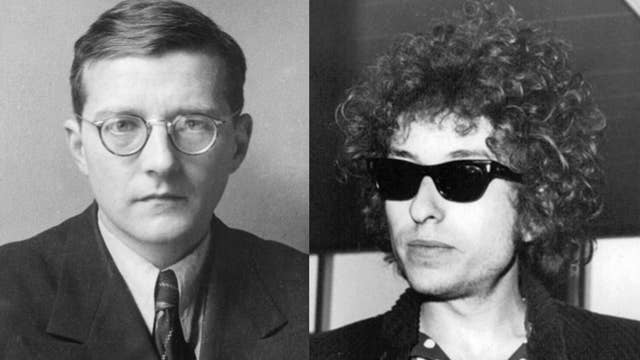
For many of us, reading the program notes is an essential part of our concert routine.
We arrive at the venue, double check which door we’re headed to, apologetically squeeze past the people already seated in our row, sit down with a happy sigh and start flicking through the booklet, ready to learn more about the music we’re about to hear and the people who are about to play it for us. For everyone from symphony newcomers to seasoned listeners, a good program note can offer us precious context for music that was often written well before we were born, in countries thousands of kilometres away, in a language we might not speak.
The notion of a concert program is quite recent. The practice emerged in England in the middle of the 19th century, as the middle class (and its access to music) grew substantially, and academics and concert directors sought to guide their listeners through a piece’s compositional structure. Over time, biographical information about composers and performers was seen as a worthy addition, again to give audiences more context but also to (hopefully) increase their enjoyment. Modern audiences are familiar with this kind of literature outside of the concert hall too, in the form of wall tags in galleries and museums, or playbills on Broadway. We are naturally curious about what makes artists tick, or what a composer’s intention is, and we hope this knowledge will illuminate our experience. But what happens if we can’t trust the information from the booklet in front of us, even if it supposedly comes from the artist themself?
This is the question scholars, musicians and audiences alike have found themselves asking about Dmitri Shostakovich’s Fifth Symphony, which the Sydney Symphony will perform with our Principal Guest Conductor Sir Donald Runnicles in September.
Do any research on Shostakovich and you will find yourself reading at length about his relationship with the Stalinist regime under which he lived. He is often portrayed as a victim, whose formidable creative force was stymied by authoritarian oppression. While it stands to reason that an artist’s output would be shaped, perhaps even defined, by the major sociopolitical conditions of their time, this portrayal has the capacity to limit our understanding of the person and the work. Never was this consideration more relevant than in 1979, when the publication of a controversial memoir offered an entirely different story behind the final bars of the composer’s Fifth Symphony.
In 1936, Shostakovich’s brutal opera Lady Macbeth of Mtsensk was denounced by the Communist Party’s official newspaper Pravda after Stalin had attended a performance. While the opera had been met with praise from Soviet officials in the years prior, Stalin took offense to the show’s complexity and vulgarity, and he was seen leaving the show early. A damning article, entitled ‘Muddle instead of Music’, was published shortly after, levelling accusations of “formalism” at the composer, and suggesting he was writing complex and esoteric music for a bourgeois audience, rather than a widely accessible style that would appeal to the working class. This withering public denigration came during the finalisation of Shostakovich’s daring Fourth Symphony, the premiere of which was ultimately cancelled amid fears it might invite further scrutiny. Chastened, he got to work writing music that catered more to the aesthetic sensibilities of the regime.
His Fifth Symphony was performed the following year and was met with superlative praise, with Shostakovich welcomed warmly back into Stalin’s good graces. The music appeared to espouse a regime-approved narrative: hero is introduced, hero undergoes psychological crisis, hero overcomes crisis with resounding victory, and the people in the streets rejoice. In particular, the final bars of the work seemed joyous and celebratory, and were met with enthusiastic ovation at the work’s premiere. The fourth movement coda marches bombastically to the work’s end, as an unyielding heartbeat from the timpani underscores a dramatic brass fanfare, while strings and winds hammer their high notes relentlessly. Critics and audiences loved it, and the composer’s reputation was restored.
But in 1979, four years after his death, the publication of an influential text cast doubt on how much Shostakovich truly intended to bend to Stalin’s will. Solomon Volkov, a Soviet musicologist, released his book Testimony, which supposedly comprised the composer’s memoirs as told to Volkov - or so he alleged. The book suggested Shostakovich’s shining finale to Symphony No.5 was in fact a cynical jab at the oppressive regime: ‘It’s as if someone were beating you with a stick and saying, “your business is rejoicing.”’ Suddenly, the image of the composer and the symphony that capitulated to political forces of the time imploded, replaced by Volkov’s conception of Shostakovich as a “hidden dissident”.
The accuracy of the memoir has always been hotly contested. In an apparent attempt to bolster the work’s validity, the first page of every chapter in Testimony has been signed by Shostakovich. However musicologist and scholar Laurel Fay has identified that these signed pages contain words copied verbatim from articles written by Shostakovich throughout his life, suggesting Volkov took some of Shostakovich’s published work and integrated it with his own (possibly fabricated) writing.
Members of Shostakovich’s immediate family also suggest Volkov did not spend nearly enough time with the composer to have written such a comprehensive account with the composer’s own words. In a 1979 interview with The New York Times, Shostakovich’s widow Irina suggests Volkov ‘was never an intimate friend of the family ‐ he never had dinner with us here, for instance.’ According to the same report, Volkov even neglected to respond to the family’s request to see the manuscript prior to its publication.
The uncertainty surrounding Volkov’s text has artistic implications too, as conductors must decide which version of events should govern their own interpretations. Choosing a faster, more buoyant tempo for the coda might suggest a celebratory interpretation, whereas a slower speed can create a heavy, ominous effect, more reminiscent of Volkov’s so-called ‘forced rejoicing.’ Musicologist Peter Kupfer has extensively catalogued the time taken by conductors for the final section of the symphony’s closing movement, with results ranging from 37 seconds for Serge Koussevitzky’s 1948 performance with the Boston Symphony to more than two minutes for Kurt Masur with the London Philharmonic in 2004. We can’t be certain whether the publication of Testimony contributed to such a discrepancy between these approaches, but it’s clear the understanding of this musical passage is still up for debate.
Far from being a collection of harmless furphies, the book posed considerable danger for Shostakovich’s reputation and that of his family, as it outed him as supposedly anti-Soviet – a label that could have cost him dearly after his 1936 denunciation. But it also posed a larger question about how we understand art as individuals:
If a piece can be reasonably interpreted in diametrically opposite ways, then does the composer’s true intent have any credence at all? Or is it an audience’s responsibility to decide meaning for themselves?
While we might feel more inclined to look to biography to augment our understanding of more abstract genres, like wordless classical music, examples of this dissonance between intent and interpretation exist in popular music as well. It is one thing for memoirists like Solomon Volkov to misrepresent their subjects (especially when the subject can no longer corroborate their claims) but is another entirely for a subject to deliberately misrepresent themselves. This is the modus operandi of legendary artist Bob Dylan, whose 2004 memoir Chronicles: Volume One (to which there is still no sequel) has long been scrutinised for its famed inconsistencies, plagiarism and flat-out inaccuracies.
For example, Dylan recounts a serious motorcycle accident in1966, shortly after he was met with vitriolic derision from his audience of folk devotees who were disappointed at his use of electric instruments. This accident has always been shrouded in mystery, given there are no hospital or police records, and many believe Dylan used the event as a way to largely avoid the spotlight for the next decade. Dylan has also made contradictory statements about his use (or lack thereof) of drugs like heroin. Perhaps the starkest indication that his autobiography wavers somewhat between fiction and reality is his well-documented borrowing from other texts, including works by Marcel Proust, Mark Twain and Jack London.
But Chronicles’ tenuous connection with the truth doesn’t necessarily prevent it from illuminating aspects of Bob Dylan’s history and psyche. As Professor Graley Herren of Xavier University writes: ‘Far from dismissing Chronicles as a fraud, I admire it as a deeply truthful fiction.’ Rather, it exists as a thread within the broader tapestry of the collection of disparate selves and identities that construct the persona of Bob Dylan. In many ways, this is also the function of Volkov’s Testimony; another artefact that contributes to the mythology of Shostakovich and the mystique of his work.
The line between fiction and nonfiction is not drawn so clearly in music as it is in, say, literature, perhaps because music, particularly instrumental, is not the language we use for objectivity. It is usually simple to distinguish between written events that did or didn’t happen, or literary places that do or don’t exist. A piece of music can endeavour to conjure similar worlds and stories, but they are often amorphous or transient, so we look for scaffolding in the physical world to contextualise it for us. We look to significant biographical texts to learn what the composer sought to achieve or emulate or evoke with a particular work, such that we may sit there and evoke it ourselves. It is tempting to believe that an artist’s words about their own work are the most prescient or accurate in defining our enjoyment or understanding of the work. But if these words can so easily be rendered erroneously by a biographer, or misinterpreted, or deliberately falsified, it is important not to shirk our own responsibility as listeners to find meaning as it appears to us.
In a 2004 interview for the Los Angeles Times, Dylan told critic Robert Hillburn that ‘it doesn’t really matter where a song comes from. It just matters where it takes you.’ We might say the same of the ending of Shostakovich’s Fifth Symphony; whether it’s defined by anger and dissent, or victory and celebration, it must be heard to fully exist – and the listener is a key piece in the puzzle of meaning. In the same interview, when asked about the meaning of his song Just Like a Woman, Dylan seems to answer with that in mind.
‘Even if I could tell you what the song was about I wouldn’t. It’s up to the listener to figure out what it means to him.’