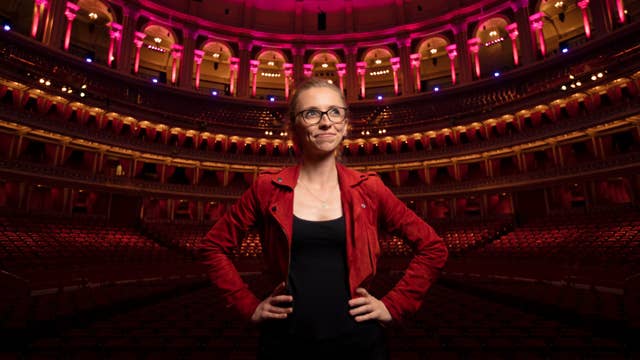
Every now and again a new personality crashes through the classical music atmosphere like a comet, blazing across the sky and immediately catching everyone’s attention. Nobody ever knows who it will be, but some strange alchemy of talent, charisma and timing combusts to create a brilliant new star.
Anna Lapwood is the newest phenomenon in classical music. The English organist, conductor, educator and composer has become a global superstar, with sold out concerts around the world, major commissions written for her by today’s leading composers, a record deal with Sony, hosting gigs on TV and radio and the TikTok account that started it all recently ticking over 1.5 million followers.
This month Lapwood makes her first trip to Australia for a two-week residency with the Sydney Symphony Orchestra – performing two solo recitals and two mainstage programs with the full Orchestra (one with Saint-Saëns’ Organ Symphony, the other with two Australian premieres of works commissioned for her), as well as a masterclass, a workshop and a schools concert – an extraordinarily busy and broad schedule of events that reflects her boundless energy and desire to connect with audiences across the demographic spectrum.
‘It's going to be fun,’ she enthuses from a hotel room in Dresden. ‘I have been excited about this residency for months now. It's all music that I adore playing. It all sort satisfies a different bit of my musical brain, I guess.
‘Playing the Saint-Saëns, you basically have the best seat in the house, and you get to sit and experience the orchestra making incredible music around you and then you get to bring it all together at the end all while enjoying the party.
‘Then the Max Richter is incredibly moving. I premiered it last year and I was crying by the end. I think what Max does so well is write tricky emotions into music – we've seen that with all the awards his score for Hamnet has picked up in the last month. And he's done that in this piece as well in a really poignant way. The Arakelyan is like the total opposite – it’s this extrovert party, an explosion of joy and colour.
‘And for the solo recital I'm going to be doing some of my new Lord of the Rings Organ Symphony, which I am so excited about getting to play. So basically all of it is pieces I adore playing and getting to play at the Sydney Opera House on that organ. You can't really complain, can you?’

Of course as is so often the case, Lapwood toiled for years before becoming an overnight sensation. She was a voracious and obviously gifted musician as a child, beginning with piano at four, picking up all of her older siblings’ instruments out of curiosity before narrowing her focus to the harp to the point that she was principal harpist for the National Youth Orchestra of Great Britain and the Junior Royal Academy of Music Symphony Orchestra.
‘Harp was my principal instrument for many years, and I was basically set on being a professional harpist,’ recalls Lapwood. ‘And then my mum said to me one day, “have you ever thought of taking up the organ?” And I was like, “don't be ridiculous, it's a silly instrument. No one likes the organ. I hate the organ.”
‘And then she told me that organ scholars at Oxford and Cambridge get a grand piano in their room at university. And I was like, “Okay, I've changed my mind. Organ is a great instrument.” And that was how I started.
‘It's funny, I really didn't warm to it at first. I found it so hard. I mean, I had taken up so many instruments by that point and like got to a high standard on five, six instruments, and this was by far the hardest I'd ever encountered. I felt kind of quite stuck with it at first. But then I think there was something about that that made me really determined to figure out how to overcome that sticking point and figure out how to do it.’
What a career it has been since. Lapwood did indeed win entry to Oxford, to Magdalen College, the first woman in the college's 560-year history to be awarded an organ scholarship. In 2016, at just 21, she was appointed Director of Music of Pembroke College, Cambridge, the youngest person to hold an equivalent position of an Oxford or Cambridge university college. In 2022 she was appointed an associate artist at London’s Royal Albert Hall, then in 2025 was named the Hall’s first-ever official organist in its 150-year history.
Those are the headline appointments, but at the same time Lapwood has been growing an enormous following on social media, confounding traditional ideas about who the audience is for classical music and the organ. Clips of her playing with non-classical artists like Bonobo and Raye, or for a Ministry of Sound electronica concert, went viral, exposing millions to the unique power and impact of a grand pipe organ like that of the Royal Albert Hall. And that broad and diverse audience has given Lapwood a freedom she never imagined she would have as an organist and chorister.
‘I increasingly am very suspicious of genre boundaries. And this generation, the young generation at the moment don't really listen to genre boundaries. They might use them as a slightly helpful label occasionally, but they don't care about them. They will listen to the music that they find interesting and exciting, no matter the genre.
‘I think it's a really exciting time for us in the classical camp – though we really should be thinking of it as the “this bit of music” camp. The audience is ready and waiting and wanting to discover what it is that we love about the music that we perform – we just have to find a way to make that initial connection.’

Nowhere is that philosophy clearer than in the repertoire Lapwood will be performing in Sydney. Saint-Saëns’ Organ Symphony is one of the cornerstones of the repertoire for organ with orchestra, while two brand-new works commissioned for Lapwood – by Max Richter and by Kristina Arakelyan – will receive their Australian debuts. Her solo recital program captures her attitude even more clearly, with music by 19th century French organist-composer Eugène Gigout sitting alongside contemporary classical works and transcriptions of film soundtracks by John Williams and Hans Zimmer.
‘I feel like I've got more confident with just programming the music that I want to play,’ says Lapwood when asked to describe how she goes about building a concert program. ‘I don't mean that to sound arrogant or cocky. But I used to always be worried about pleasing the critics, pleasing the people who probably wouldn't like what I was doing anyway. But now I'm just going to program the music that I feel really passionate about at the moment and hope that is what my audience wants to hear.
‘And I feel very lucky that actually, in terms of my main audience – which is a lot of people who maybe haven't heard the organ before, or maybe haven't been to a classical concert before – I feel very lucky that they really love my programs, because it's the music that I adore playing.
‘I also try and keep my programs relatively flexible. When I originally submitted my program for the Sydney show, I hadn't written the Lord of the Rings Organ Symphony – it didn't exist. But then I finished it about two weeks ago and realised that had to play some of this, because it is my current hyper fixation. And I feel really lucky when promoters and venues are open to that because I think they know that that's how I work.
‘But what I try to do in my concerts is, yes, there will be film music in there, but I try and use that as bit of sort of stepping stone. I will always include some contemporary music by female composers: there's a piece of Olivia Belli that I play in almost all of my concerts. And often it's the piece that people say is their favourite when they leave. And it's nothing to do with film music, it's just a really beautiful piece of storytelling.
‘So I always try and have that mix, and have at least one piece from the more classical rep there. I know there are always going to be people with strong opinions about programming. Often people are ask why I don’t play Bach – but there are so many organists who play Bach so incredibly well, better than I can play it, and that is not music where I feel I have something different and authentic to say at this point in time.
‘I think audiences can tell what your relationship is with a piece of music and their experience of it is impacted by that. If they feel like you are trying to prove your way through a piece of music, I think they then listen with a kind of nervousness. Whereas the thing with the film scores – and it's not that they're easier at all, they are blooming hard, let me tell you that – but there's something about the fact that I feel a sense of ownership over them, and I feel like my relationship with the instrument is now defined through those transcriptions. And that is how I fall in love with the instrument.
‘So when I go out on stage performing them, it's not that I'm not kind of having to work really hard while performing them, it's that there isn't a sense of proving. I am just so excited to share this music with this group of people, and I think that means that people are much more likely to then fall in love with the music because they can feel it from you.’