Going to an orchestral performance is not new for me—I’ve been doing it for almost 20 years.

In the Sydney Opera House’s Concert Hall alone, I’ve sat close to the front, at the very back, high in the circles above the stage, and even behind the percussion section when I sang with the Symphony Chorus.
But the tactile tour and audio‑described performance by the Sydney Symphony Orchestra (SSO) on Saturday 1 August 2026 still blew my mind.
A couple of disclaimers before I go on.
This is not a review of the music, although I can sum up the SSO’s performance of Elgar’s Cello Concerto (featuring Sheku Kanneh‑Mason) and Strauss’s Alpine Symphony in one word: sublime.
I do maintain an ongoing conversation with the Sydney Opera House Access team, which delivered the tactile tour and audio description services, but I don’t work for them.
I was simply an audience member who is blind, and a musician.
What is a Tactile Tour?
Most people who walk into the Concert Hall can immediately see what it looks like—where the orchestra sits, how they’re arranged, the position of the conductor, and even the colour of the sound‑reflecting “petals” that adorn the stage.
If you’re blind, most of this information isn’t available at a glance.
I know where I sit in relation to the orchestra when they’re playing, and I can guess their layout because I know what most orchestral instruments sound like.
I’d heard about the big acoustic “thingies” above the stage—installed after decades of the Concert Hall failing to win any “Best Acoustic Setup” awards, prompting a multi‑million‑dollar refurbishment in 2020.
But it wasn’t until a few months ago, while working as a featured artist at the Sydney Opera House, that I began to understand the building’s architectural uniqueness through a tactile kit developed by the Access team. One of the items was a miniature pink “petal” made from Perspex.
An hour before the SSO concert began, patrons who are blind or have low vision were guided from the foyer into the Concert Hall. Rebecca was the lead describer, assisted by Emma, and members of the SSO team—including Sam, a horn player—were also present.
Soon after entering the hall, we were invited onto the stage.
I’d always imagined the stage as a high, raised platform. It turned out to be not as high as I thought.
From the front, getting on the stage involves climbing a series of steps, which on this occasion wasn’t a problem.
We were allowed to feel the adjustable risers—luxuries many venues don’t have.
Then came the star attraction: the alphorn, featured in Strauss’s Alpine Symphony.
Sam, one of the orchestra’s horn players, let me trace my hand down the length of the instrument—all four meters of it.

Up to this point, I only knew about alphorns from compiling a glossary of instruments for the ABC, so to encounter it in real life was very special.
Sam explained how it works (it can only play harmonics, like a bugle) and even played a few notes for us.
Another highlight was feeling the platform set up next to the conductor’s podium, where Sheku Kanneh‑Mason, the soloist for the Elgar Cello Concerto, would sit during the performance.
Rebecca described it as “a coffin‑shaped platform.”
What struck me was its texture: the smooth wood had been repeatedly carved by cellists’ spikes over the years.
Audio describing live music
The concert on August 1 marked the first time the SSO offered audio description services.
For those unfamiliar with audio description: it’s a service that describes what’s happening on stage during a live performance.
Patrons who requested the service were given a radio pack and wired earbuds.
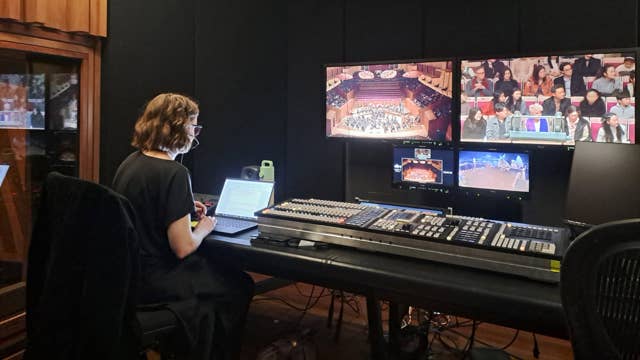
While patrons find their seats, Rebecca descended into the broadcast studio deep within the Opera House to watch the concert through a set of cameras and describe it live. Meanwhile, patrons like me listened through our receivers from wherever we were seated.
Most descriptions were delivered before the music began, between movements, or after the final notes—when things like musicians entering the hall, bowing to the audience, acknowledgements of soloists, and the quick exit‑and‑return routines naturally happen.
The audio description of this concert strongly reminded me of radio—particularly Lunchtime Concert and Classic Live on ABC Classic.
However, it was designed for patrons who are blind or have low vision, and the description focused solely on the visual elements on stage.
I suggested that Rebecca incorporate movement names and numbers into her script, a helpful cue I learned from listening to my colleagues present concerts.
What’s the point of audio describing a symphony orchestral performance?
From time to time, people remind me that the point of an orchestral concert is the music, not what’s happening on stage.
While this is correct, it doesn’t mean that I’m getting a complete experience through the music alone (I have music streaming for that).
I learned things I didn’t know I didn’t know during last weekend’s performance.
For instance, I never realised that although the oboist gives the tuning note, it’s the concertmaster who cues the orchestra that it’s time to tune.
I also like expressing my appreciation vocally during applause, so it was helpful to know the right moment to “yoohoo” Sheku, Simone Young and the alphorn players.

Not all SSO offerings are purely musical.
Recently, I attended a concert based on the music of The Lord of the Rings, and a symphonic cinema concert featuring a silent film alongside Holst’s The Planets.
The SSO also has films‑in‑concert performances as part of its regular programming. They did How to Train Your Dragon II back in June.
And in October, they’ll be presenting Star Wars: The Empire Strikes Back.
2026 also marks the conclusion of the orchestra’s multi‑year Wagner Ring Cycle journey, with Simone Young conducting Twilight of the Gods in November.
These events aren’t yet part of the audio‑described offerings.
My hope is that the SSO and the Sydney Opera House will continue collaborating and expanding their audio description offerings.
Because if I learned anything this year, it’s that I wouldn’t sit through hours of live performance without audio description ever again.
At least without being strongly tempted to line up a knitting tutorial video while the show goes on.
This was originally posted on Substack and reshared with the author's permission.