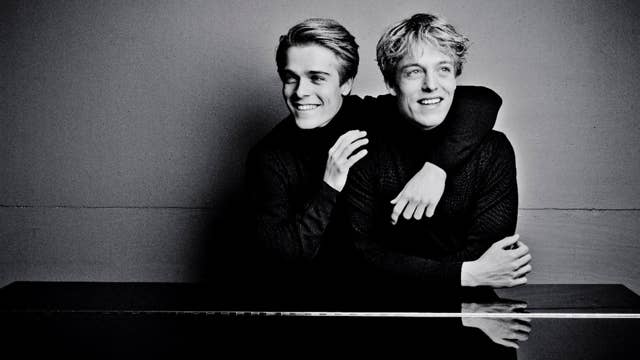
Being stuck in the same room as your sibling day-in, day-out would be torture for some, but Dutch brothers Lucas and Arthur Jussen are the very picture of brotherly harmony…
There is a perception, certainly in Australia, that the arts and sport are incongruous with one another: that there is no poetry in a cover drive, no ballet in a scrum, no music in the roar of the crowd. Yet for Dutch pianists and brothers Lucas and Arthur Jussen, it was sport that ignited a love for music that has seen them ascend the very peak of the classical music world.
It all started with the 1998 soccer world cup, in which the Netherlands side would finish fourth. ‘I would watch all the games with the family, and before every game they played the national anthem,’ remembers Lucas, the elder by three and a half years. ‘My mother had a piano book for children which included the Dutch anthem, which she taught me to play, and afterwards they asked me if I would like to have serious piano lessons. That's basically how it started – so without football, no piano for Lucas!’
In the way of siblings Arthur was either going to be drawn to the piano or reject it out of hand, but by the time he was five they were making music together at the same keyboard.
As they got older they practiced and performed individually, pursuing their own goals and certainly never planning a career as a piano duo.
‘We just took it step by step,’ says Arthur, ‘and the duo career just came very naturally. And maybe the beauty of not having any expectations is that it has been able to become what it is today.’
%20Jesaja%20Hizkia%20-%202400x1350.png?w=600&h=600&f=cover&fx=50&fy=50)
Those of us with siblings might wonder how they have been able to be joined at the hip for more than 20 years without coming to blows, but interviewing them together there is a natural ease and back-and-forth that clearly follows them on stage. But they have certainly put some structure into their work to keep things on an equilibrium, in particular around roles at the piano.
‘We very consciously always switch, though not within the same piece,’ explains Lucas. ‘Once I’ve learned a particular part I will always play that particular part – we’re too lazy to learn both parts!
‘That's a decision that we took quite early on…otherwise people start to say, “he's really the bass player,” and “he’s really the melodist”, and whether or not that's true actually doesn't matter. But if people always see you in that particular role, they will always picture you in that role. And we think we're capable of doing both very well, and we wanted to convey that to the audience. Never give them a chance to put us put a sticker on one of us and saying he is that and he is that. We're both everything and we wanted to keep it that way.’
‘I think that it is also nice for the audience that there is confusion about who is actually playing what and where and when. We love that, because in the end that shouldn't be important. What is important is that the experience as a whole is pleasurable and memorable, and the personal thing of who's playing what is actually not important. So we're very happy to create a little bit of confusion on the stage.’

That sense of fun and playfulness finds a perfect match in the music they are playing today, the Concerto for Two Pianos and Orchestra by French composer Francis Poulenc. It’s full of interesting musical Easter eggs
‘It’s a really fun piece to play,’ says Arthur with a smile. ‘It’s a mix of so many different styles.’
‘Poulenc was very good at – well, “stealing” is a big word – but taking things from other composers. And he was the genius who put everything together and put his own Poulenc sauce over it.’
‘It starts off very virtuoso but it also has very beautiful parts. The second movement is just like a Mozart concerto. You cannot be bored while playing it but also while listening to it – and we love that piece from the bottom of our hearts.’
Lucas picks up where his brother leaves off: ‘the music sometimes feels crazy…[there’s] so many notes going through each other. You don't really know what's happening, but playing-wise it feels incredibly comfortable. And that's where the power lies of great composers, that he was able to do that.’
‘Apart from that, yeah, it's a lot of fun to play – and always fun to play it with a new orchestra, because we know what's coming, but to see in the eyes of the musicians, like, “Wow, that's didn't expect that!” – and then also in the eyes of the of the audience who's going listen to it, that's really nice.’
‘And I think also that’s a big advantage that we as a duo have: if an audience goes to Beethoven's Fifth or Mahler Two or Tchaikovsky Violin Concerto, they have a very clear picture of what's coming – but with piano duo repertoire we still have the possibility to surprise people with what we're playing. And if the hall is full and a lot of people are there, it's wonderful to be able to give that surprise to people of this Francis Poulenc concerto.’

